13/06
So I was going away. But then the weather did what it has a knack for - something inconvenient. After weeks of mostly settled, warm, dry weather, an intense storm is due to blast through tomorrow morning. Things I could have left in my absence - pots and trays, but also the greenhouse - needed to be secured. So I've put off going for a few more days, because this year I will not be thwarted.
~~~
14/06
So the storm has come and largely gone. Little damage, thankfully. The trees were whipped about, and at this time of year when they are fully clothed, they can more easily be brought down by a gale, but we were lucky. The greenhouse was about the most solid thing in the garden as it turned out - partly because I bit the bullet and did what I had been putting off, namely fixing the base down to the platform beneath. I have a mild aversion to certain things, and drilling through metal and masonry is not a favourite activity, but it had to be done eventually, and I wanted the structure to have a good chance. In fact, the sheer weight of the glazing holds it down for the most part, but this was insurance (and prevents the whole thing shifting). Now I've started, it's less daunting, and I'll finish soon.
The greenhouse was warm and calm today, while outside it was cool and violently blustery. I've moved more plants in already than can live there permanently, but it was a wise choice. Although many tomatoes I sowed and potted on haven't thrived, I have enough plants now to get a good crop even if no more are useable. Ditto chillies, peppers, and aubergines. Melons and cucumbers, I'm not sure about, and the okra have sulked since I potted them on a few weeks ago.
I also took delivery today of a new thing - coir. I have consumed hundreds of litres of compost in the last few weeks - various types, though I try to avoid peat-based ones as those are environmentally damaging. Coir is useful as an alternative, and has the great advantage of being sold in dry, compressed blocks. I got three today, just to see - each one is 5kg and rehydrates to approximately 70 litres. I will mix it with well-rotted horse manure, which I've been using neat but leaves a bit to be desired, especially with regard to its texture, and some chicken manure/seaweed pellets as fertiliser, as I have them lying around. The tomatoes may do fine in this, but I'll use at least one other medium for some plants, just to hedge my bets.
~~~
15/06
Still blustery, cool, and largely grey today. The greenhouse seems perennially warm though, which is great. It shouldn't surprise me, but it does. I've started putting the planting medium down (the perimeter base is much higher than the internal ground surface - between four and ten inches - and the difference will be made up with whatever good stuff I can obtain). To start with I'm trying a mix as outlined above of about 40% coir, 60% manure, with seaweed fertiliser pellets for extra oomph. I'll also probably cut and lay some nettle and comfrey leaves around, to break down as a slow release nutrient source. The first plant has gone in, too - an aubergine. I'm using twine supports buried under each plant and tied to the roof trusses, although the positioning of the latter may mean I need canes for some plants too. It'll be a learning process this year - what works in *this* greenhouse. I've plenty of plants to fill the place, it's just a matter of keeping them happy now.
I leave tomorrow, for the best part of a week. I hope most things survive okay. The weather looks mixed, which is ideal - too much hot sun would dry everything out (although I'm watering as thoroughly as possible before I go), and wind would be unwelcome. But sunny spells and showers - more typical June weather - would be perfect for once.
~~~
16/06
It rained heavily this morning, so I needn't have worried about outdoor watering. I soaked the plants under cover - some really should be in their final positions by now, but they'll just have to wait.
Harvests:
13/06 - 40g spinach, 15g spinach beet
15/06 - 150g lettuce
16/06 - ~50g strawberries*
YTD total: 1.195kg
*not weighed, so estimated (two largish fruits, three small ones).
Saturday, 16 June 2018

Monday, 11 June 2018
A break
For once I wrote this and took the pictures all in one day!


I have to go away for a few days. I'd rather not, but it will perhaps push me to do some chores I had been putting off.
A lot has changed in the week and a half since I wrote the previous entry (although I only published it today). The last of spring passed away quickly - the hawthorn came and went in a flash. The weather has continued mostly very dry and warm, although there's been more night-time cloud and fog, and a few showers. But not enough for watering not to still be necessary.

The outdoor broad beans are now in full bloom. Two varieties, 'Crimson flowered' and 'Red Epicure' - the former with decorative blooms has thrived, and is now waist high with hundreds of potential pods, the latter with red-brown seeds rather than green does not look healthy. Why the difference? Hard to say, but the beds are in subtly different positions, one is filled with manure while the other got well-rotted compost and a bit of chicken and seaweed fertiliser. Peas in the thriving bean bed are also in bloom, with baby pods. I pulled the last of the radishes sown as a catch crop between onions, as the latter are starting to bulk up and were being shaded, and to be honest I've had enough radishes now (though I will sow some more today for later in the summer).

I've set up the last wicker-edged planters - turns out we had more than I originally realised. Four are very large, divided into two compartments. One is split between vegetables (in a picture in the previous entry - beetroot, spinach beet, spring onions, and turnips) and flowers - a large white foxglove which will be replaced by sweet peas. Another with rows of sunflowers, ruby chard, and mimulus - all in reds and oranges. A third with red kale on one side, red cabbages on the other, which will host the catch crop of radishes I mentioned above. And the final one half with tall peas, and the other half with more red cabbages and probably a catch crop of turnips. Medium-sized planters with herbs (thyme, borage, hyssop, and chives) and flowers (cosmos and petunia), beetroot, and onions respectively. Small ones with lettuce, lettuce and spring onions, and calendula (classic 'English' marigolds) respectively.
I've moved a lot of tender plants to the greenhouse, where some will live permanently, and others be put in the polytunnel - chillies, peppers, tomatoes, and aubergines. The first courgette was put into its final position, a large pot, but many others are budding and need to be planted soon. Ditto summer beans - of which there are many, with more to sow. The other brassicas are pretty much all potted on, and will keep for a couple more weeks, but then I'll need to find somewhere for them - I have a couple more raised bed edges I can set up once I decide where. Hundreds of smaller pots contain lettuces, chard, alliums, and all sorts of other things, and again I'm not sure where they'll go - but at least the red lettuce 'Bijou' is attractive enough that I may use it as an ornamental edging in pots of flowers, or even the flower beds. Then there's seedlings of things sown in May - broccoli, more cabbages, more lettuces, beets, spinach, and all sorts of other things. Hopefully planting out will free up pots, and everything will move up a category - with the module trays then free for more seeds, things like beetroot and onions than can be planted after some crops are pulled in the next couple of months.

In the ground, the outdoor-sown beets are now growing well, at last, as is garlic and more peas. I want to plant onions, and the first courgettes, winter squash, and summer beans, as soon as possible - rather than clearing the overgrown beds, I'm hoping a no-dig approach of hacking back the invasive plants (like goldenrod), covering with a lot of manure and compost, and then black polythene will work - at least for the cucurbits which are spaced widely.
So I have to go away for a few days, and it feels frantic. But it has for weeks. Maybe it'll all be worth it. Perhaps this is the year I test my desire for a vegetable garden to breaking point.

Crops:
11/06 - 90g radishes
YTD total: 940g


A clearer view of some of the plants photographed in the last entry. Anxiety-inducing! Note the dark red-purple lettuce 'Bijou'.

The one onion bed that is doing okay, which had a catch crop of radishes in between until I pulled the last ones today.
I have to go away for a few days. I'd rather not, but it will perhaps push me to do some chores I had been putting off.
A lot has changed in the week and a half since I wrote the previous entry (although I only published it today). The last of spring passed away quickly - the hawthorn came and went in a flash. The weather has continued mostly very dry and warm, although there's been more night-time cloud and fog, and a few showers. But not enough for watering not to still be necessary.

Crimson-flowered broad beans, looking healthy (I've never had a problem with blackfly and this year seems no different!).
The outdoor broad beans are now in full bloom. Two varieties, 'Crimson flowered' and 'Red Epicure' - the former with decorative blooms has thrived, and is now waist high with hundreds of potential pods, the latter with red-brown seeds rather than green does not look healthy. Why the difference? Hard to say, but the beds are in subtly different positions, one is filled with manure while the other got well-rotted compost and a bit of chicken and seaweed fertiliser. Peas in the thriving bean bed are also in bloom, with baby pods. I pulled the last of the radishes sown as a catch crop between onions, as the latter are starting to bulk up and were being shaded, and to be honest I've had enough radishes now (though I will sow some more today for later in the summer).

Beetroot sown straight into the ground about two-and-a-half months ago, under cloches at first. Lower left: spring onions, upper right: garlic.
I've set up the last wicker-edged planters - turns out we had more than I originally realised. Four are very large, divided into two compartments. One is split between vegetables (in a picture in the previous entry - beetroot, spinach beet, spring onions, and turnips) and flowers - a large white foxglove which will be replaced by sweet peas. Another with rows of sunflowers, ruby chard, and mimulus - all in reds and oranges. A third with red kale on one side, red cabbages on the other, which will host the catch crop of radishes I mentioned above. And the final one half with tall peas, and the other half with more red cabbages and probably a catch crop of turnips. Medium-sized planters with herbs (thyme, borage, hyssop, and chives) and flowers (cosmos and petunia), beetroot, and onions respectively. Small ones with lettuce, lettuce and spring onions, and calendula (classic 'English' marigolds) respectively.
I've moved a lot of tender plants to the greenhouse, where some will live permanently, and others be put in the polytunnel - chillies, peppers, tomatoes, and aubergines. The first courgette was put into its final position, a large pot, but many others are budding and need to be planted soon. Ditto summer beans - of which there are many, with more to sow. The other brassicas are pretty much all potted on, and will keep for a couple more weeks, but then I'll need to find somewhere for them - I have a couple more raised bed edges I can set up once I decide where. Hundreds of smaller pots contain lettuces, chard, alliums, and all sorts of other things, and again I'm not sure where they'll go - but at least the red lettuce 'Bijou' is attractive enough that I may use it as an ornamental edging in pots of flowers, or even the flower beds. Then there's seedlings of things sown in May - broccoli, more cabbages, more lettuces, beets, spinach, and all sorts of other things. Hopefully planting out will free up pots, and everything will move up a category - with the module trays then free for more seeds, things like beetroot and onions than can be planted after some crops are pulled in the next couple of months.

One of the first tomato flowers - several plants now have them open. Probably the variety 'Moneymaker'.
In the ground, the outdoor-sown beets are now growing well, at last, as is garlic and more peas. I want to plant onions, and the first courgettes, winter squash, and summer beans, as soon as possible - rather than clearing the overgrown beds, I'm hoping a no-dig approach of hacking back the invasive plants (like goldenrod), covering with a lot of manure and compost, and then black polythene will work - at least for the cucurbits which are spaced widely.
So I have to go away for a few days, and it feels frantic. But it has for weeks. Maybe it'll all be worth it. Perhaps this is the year I test my desire for a vegetable garden to breaking point.

At centre, a tiny embryonic courgette, the first of many, I hope! I've never managed a respectable crop of them, but this year I have enough plants to be in with a chance.
Crops:
11/06 - 90g radishes
YTD total: 940g

A crop to come: one of the first pea pods (this is 'Kelvedon Wonder').
Summer
Once again I wrote this well over a week ago, and it languished awaiting photos.

As I may have said before on this blog, I consider the start of summer to be the 1st of June (as does the Met Office). That view was developed when I lived in England, and it's certainly less apt up here in Scotland, but nonetheless, it seems odd to talk of June as anything but summer.
Having said that, some spring things haven't yet happened. Hawthorn - 'May' - is only just coming out here. We have a fairly large, mature specimen in a far corner of the garden, and plenty of seedlings have spread around, one of which near the house is large enough to flower this year - it's started to open, sooner than the other one, but perhaps it's the impetuousness of youth. Alliums (the ornamental kind) are just opening. Whether their lateness is due to being planted in February (I am bad with bulbs), or if that's the normal way up here, I can't say - but they are also really late spring flowers, in my mind. On the other hand, the weather has been that of high summer - days and days of heat (up to the mid twenties Celsius), sunshine, and humidity, although nights have often been cool, and fog has crept in from the east from time to time.

The larger tomatoes are already forming flowers, and some courgettes are likewise developing embryonic buds, which is especially unexpected. It's been a case of watering and juggling plants around to find cooler, shadier spots, which I hadn't expected, but gardeners must be supremely adaptable in this country. I love heat, and sunshine, so I can't complain. Combined with the long days we get at this time of year - sixteen or seventeen hours between sunrise and sunset, and an hour either side of twilight - and there's enough time to do most things. It's langorous, or would be if there wasn't quite *so* much to do.
My major project of May, which I will reveal once it's done*, is nearing its end. Otherwise, I've done a lot of clearing, rearranging, and sprucing up of areas that have been neglected for a long time - not 'tidying', which is a noxious term in gardening I find, but just bringing things into focus a little more. There's still plenty of wildness in the garden, and that's good.
As for specifics, the broad beans are flowering in the polytunnel, and budding outside. Radishes are abundant. Lettuces and spinach provide a modest crop every few days. Brassicas, still waiting for a permanent home, are being potted on and on. Most things continue to grow well, although some haven't thrived. I should have enough of almost everything, if things continue the way they have been. I'd let out a sigh of relief, but it's not time for that quite yet.
31/05 - 90g radishes
03/06 - 10g lettuce
04/06 - 250g radishes**
07/06 - 40g spinach
09/06 - 50g lettuce, 100g radishes
YTD total: 850g
Also several hundred grammes of lovage, but as I didn't plant it (it was here when we moved in), I haven't counted it. The plant grows fast - it dies back in winter, but by June it can get to seven feet tall, and when it flowers later in summer, even taller. I've removed the flowering stems this time, as I want to prolong it (though the seeds are edible as a spice, and the flowers very attractive to insects).
*I obviously already published the entry on this.
**Previously I was weighing the radish plants whole, including the leaves, because they were small and tender. But now the leaves are a bit big and prickly to eat (I guess you could cook them), so I just weighed the 'bulbs'.


Lettuce 'Yugoslavian Red' and some tiny spring onions, in a wicker-edged bag planter - I would not choose these, but they were freely available and I need all the planting space I can get right now.
As I may have said before on this blog, I consider the start of summer to be the 1st of June (as does the Met Office). That view was developed when I lived in England, and it's certainly less apt up here in Scotland, but nonetheless, it seems odd to talk of June as anything but summer.
Having said that, some spring things haven't yet happened. Hawthorn - 'May' - is only just coming out here. We have a fairly large, mature specimen in a far corner of the garden, and plenty of seedlings have spread around, one of which near the house is large enough to flower this year - it's started to open, sooner than the other one, but perhaps it's the impetuousness of youth. Alliums (the ornamental kind) are just opening. Whether their lateness is due to being planted in February (I am bad with bulbs), or if that's the normal way up here, I can't say - but they are also really late spring flowers, in my mind. On the other hand, the weather has been that of high summer - days and days of heat (up to the mid twenties Celsius), sunshine, and humidity, although nights have often been cool, and fog has crept in from the east from time to time.

Another wicker-edged container with probably-too-closely-planted beetroot, spinach beet, spring onions, and turnips.
The larger tomatoes are already forming flowers, and some courgettes are likewise developing embryonic buds, which is especially unexpected. It's been a case of watering and juggling plants around to find cooler, shadier spots, which I hadn't expected, but gardeners must be supremely adaptable in this country. I love heat, and sunshine, so I can't complain. Combined with the long days we get at this time of year - sixteen or seventeen hours between sunrise and sunset, and an hour either side of twilight - and there's enough time to do most things. It's langorous, or would be if there wasn't quite *so* much to do.
My major project of May, which I will reveal once it's done*, is nearing its end. Otherwise, I've done a lot of clearing, rearranging, and sprucing up of areas that have been neglected for a long time - not 'tidying', which is a noxious term in gardening I find, but just bringing things into focus a little more. There's still plenty of wildness in the garden, and that's good.
As for specifics, the broad beans are flowering in the polytunnel, and budding outside. Radishes are abundant. Lettuces and spinach provide a modest crop every few days. Brassicas, still waiting for a permanent home, are being potted on and on. Most things continue to grow well, although some haven't thrived. I should have enough of almost everything, if things continue the way they have been. I'd let out a sigh of relief, but it's not time for that quite yet.
31/05 - 90g radishes
03/06 - 10g lettuce
04/06 - 250g radishes**
07/06 - 40g spinach
09/06 - 50g lettuce, 100g radishes
YTD total: 850g
Also several hundred grammes of lovage, but as I didn't plant it (it was here when we moved in), I haven't counted it. The plant grows fast - it dies back in winter, but by June it can get to seven feet tall, and when it flowers later in summer, even taller. I've removed the flowering stems this time, as I want to prolong it (though the seeds are edible as a spice, and the flowers very attractive to insects).
*I obviously already published the entry on this.
**Previously I was weighing the radish plants whole, including the leaves, because they were small and tender. But now the leaves are a bit big and prickly to eat (I guess you could cook them), so I just weighed the 'bulbs'.

Just some of the plants waiting to be put in their final positions - a bit daunting. Lots of brassicas, lettuces, some alliums (leeks and shallots), spinach, and ornamentals cosmos and scabious. Almost every plant here was grown from seed.
Tuesday, 5 June 2018
The big reveal
I've dropped a few cryptic hints on Twitter referring to a big project in the last few weeks, but only a couple of people know what it is. I wanted - for once! - to have completed a job before showing off the results, and finally, after over a month of hard work, and a month more of planning, I can say - it's a greenhouse!
I've never had my own "proper" greenhouse. I tried to build two a few years ago back home, but they were my own designs, built from the materials I could obtain locally, fitted into awkward sites, and never fully finished. When we moved here four and a half years ago, there was a small (~6x6 foot) one in the garden, but it was missing its door and a few panes of glass, so has never been usable. There's also a polytunnel, which in the last couple of years has also lost its door, but is still functional. However, finally I decided that for the vegetable garden to reach its potential, I wanted a fairly large, new, working greenhouse.
I found one online that was a bargain - still several hundred pounds, but reduced in price by at least 50%, with a few higher-end features than a basic model (a coloured, powder-coated aluminium frame, rather than bare metal, toughened glass, a louvred vent, etc). Then I looked into foundations - would it go on the ground, on a plinth, a patio... I decided on a perimeter base of slabs, which offered strength and solidity without taking too much more money or materials - a full patio base would have required more of both (and more work!), and I decided I wanted beds to plant into, rather than growing everything in pots, which would entail much more watering. Roughly a tonne each of ballast (mixed sand and stones) and sand, plus a few hundred kilos of slabs and cement were delivered, and I singlehandedly shovelled them into my barrow, wheeled them down, and laid the foundation. In fact, I've done the whole thing on my own - I wasn't sure if it would be possible without help, but I much prefer knowing that it was all my work. Below are progress photos from early May to early June.

Just after I started - a very overgrown section of the veg garden, with sedges, nettles, coltsfoot, and many other perennial weeds. I stripped them all out down to bare earth, also removing slabs of concrete, lengths of timber, and other accumulated rubbish from the site's previous incarnations.

Here I've laid some slabs to roughly measure out the size of the base - length and width. I drew out a plan on my computer, but it's always good to see it in position.

The slabs have been removed again, and a perimeter of ballast put in place, followed by sand.

The first side has been laid on a bed of damp sand and cement. It was important for the perimeter to be as level as possible (it looks slightly bowed here, but this seems to be an artifact of the wide angle lens).

The frame is up! I build the four sides elsewhere, then brought them in and connected them.

The roof beam and battens are in.

Almost fully glazed! Note also the base, which raises the height and provides extra strength.

The door is on, and it's pretty much done! A few twiddly bits to add, and the base needs securing, but it's now ready to use.
Monday, 28 May 2018
The end of May

The first full salad of the year - radishes and some of their leaves, lettuce, baby red kale, and spinach.
It's hard to get an overarching sense of what the garden is doing at the moment. I have to devote myself to lots of little tasks - mostly because it's how I work best, but also there is a lot to do, and I don't feel I can spend half a day on a single thing.
Things continue to grow - shockingly fast in some cases. The third lettuce sowing germinated in about four days. Many brassicas are getting to the size where they can be planted in their final position (wherever that will be), and some ornamentals like the first cosmos are likewise almost ready to be placed.
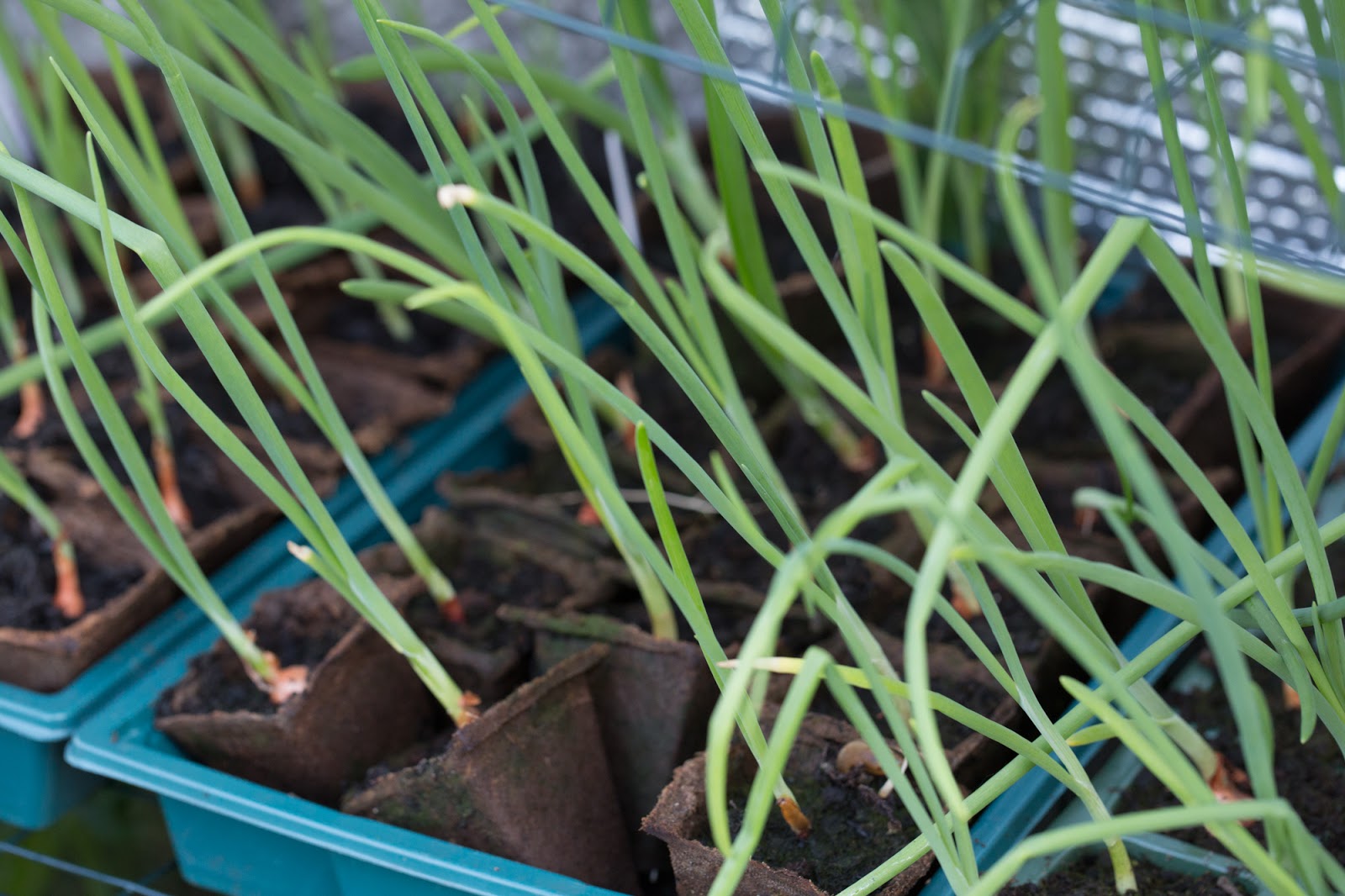
A lot of onions need to be planted - maybe I've left this a bit late, but they will probably be fine; I expect to harvest them perhaps in September. Note, these are planted in peat pots - I would not buy peat products, but these were found in the shed, and it's wasteful not to use them.
I've got on with a fair bit - the first tomatoes, several 'Moneymaker' that are head and shoulders larger than the other varieties, have been moved to the polytunnel to acclimatise. They have tiny flowers forming, and I had to pinch out the first side shoot, which seems ridiculous in May, but the weather has been so warm and fine, it's no wonder they're racing on. Funnily enough, the size of pot I put them in doesn't seem to have affected their growth - several are about a foot tall, whether they're in a litre pot or a tiny thing.

Above: some of the second sowing of lettuces, now pricked out into modules and doing well (these are mostly the dark variety 'Bijou'; below: the third sowing is already coming up after just a few days.


Cabbages, broccoli, 'Aztec broccoli'.
Harvests:
26/05 - 100g (radishes: 80g, spinach 10g, mixed salad (lettuce and kale) 10g)
27/05 - 155g radishes
28/05 - 5g spinach
Year to date total: 310g
Thursday, 24 May 2018
Late May movement
Most things are growing fine.
I tweeted that recently, and it seems an apt summary of how things are at the moment. As ever, some things are growing *too* well - mostly unwanted plants like nettles (I won't call them weeds, as they are too useful), although also some crops that haven't yet got a home. It feels cruel to sow a seed and then let the plant linger in a pot or cell that is too small for too long, but I'm managing to move most on before they get too root-bound, and in my experience, many plants simply go into a state of semi-dormancy in that case - just don't leave them so long that they either die or try to set seed.

Most repotting/pricking out has gone well. Ornamentals, which this blog isn't really about, such as cosmos (50-100 plants?), calendula (at least edible, though I'm growing it for its appearance and pollinator-friendliness), and more exotic things like Scabiosa 'Black Knight' - but also most of the veg. I have been cheered to see that the brassicas, that were not happy a couple of weeks ago, have started to grow rapidly once potted on. I'm not sure about some, like the brussels sprouts, but the red kale and red cabbages may yet thrive (see photo above). The second sowing of lettuces (see photo below), done in dense rows in a tray following Charles Dowding's method, were half pricked out a couple of days ago, and are already settling in, and yesterday I did the third sowing. The first ones, incidentally, are fewer in number but now almost big enough to pick - and thanks to being cosseted as individually-potted plants in a mini greenhouse, they are pest-free so far.

Yesterday I picked my first radishes, and today some more. I sowed some in a tray and stuck it in another mini greenhouse, but the soil was probably too poor (seed compost) and too shallow, and they wanted for light - they are only just starting to swell. But outdoors I also sowed some as a catch crop between onion sets, and these are now reaching maturity. Small but perfect, and very tasty - the whole plant is edible, so there's no waste. 50g so far, which is pitiful, but the start of good things.

Unexpectedly, the broad beans planted into the polytunnel - the first sown, but long since overtaken in size and vigour by other batches - have started to flower, even though they're very small. I don't expect much of a crop from them, but it was a rescue job, and the space will soon be needed anyhow, as I have a lot of very vigorous sweetcorn, courgettes, melons, cucumbers, tomatoes and the like that will do better there.
On the upper patio, I've started erecting new planters that once again I would not have chosen, but which weren't doing anything, and I need as much space to pop in small plants as possible now. Spring onions, turnips, beetroot, spinach beet, as well as some ornamentals as it's an area viewed fom the house (foxglove, sweet peas, and later calendula and nasturtium).

It's been dry, if not always warm and sunny - yesterday was chilly and grey for the most part, and today started that way too, although both ended fine - and dry plus fast growth means a lot of watering. Up till now I've used watering cans but for the next few weeks I will use a hose. I intend to set up some water butts (much overdue), but even they won't provide enough. Thankfully, this is generally a very wet part of the world, so I don't need to feel too guilty about using irrigation when it is dry. But watering takes such a long time - a thorough soaking of everything may only need to be done once every few days, but it takes a couple of hours, and this is before lots of much thirstier crops, like cucurbits and tomatoes, get planted. Oh well.
I tweeted that recently, and it seems an apt summary of how things are at the moment. As ever, some things are growing *too* well - mostly unwanted plants like nettles (I won't call them weeds, as they are too useful), although also some crops that haven't yet got a home. It feels cruel to sow a seed and then let the plant linger in a pot or cell that is too small for too long, but I'm managing to move most on before they get too root-bound, and in my experience, many plants simply go into a state of semi-dormancy in that case - just don't leave them so long that they either die or try to set seed.

Do they look bigger? I think they are - roots are already starting to show through the pot bottoms.
Most repotting/pricking out has gone well. Ornamentals, which this blog isn't really about, such as cosmos (50-100 plants?), calendula (at least edible, though I'm growing it for its appearance and pollinator-friendliness), and more exotic things like Scabiosa 'Black Knight' - but also most of the veg. I have been cheered to see that the brassicas, that were not happy a couple of weeks ago, have started to grow rapidly once potted on. I'm not sure about some, like the brussels sprouts, but the red kale and red cabbages may yet thrive (see photo above). The second sowing of lettuces (see photo below), done in dense rows in a tray following Charles Dowding's method, were half pricked out a couple of days ago, and are already settling in, and yesterday I did the third sowing. The first ones, incidentally, are fewer in number but now almost big enough to pick - and thanks to being cosseted as individually-potted plants in a mini greenhouse, they are pest-free so far.

More 'Mottistone', ready to be pricked out into modules.
Yesterday I picked my first radishes, and today some more. I sowed some in a tray and stuck it in another mini greenhouse, but the soil was probably too poor (seed compost) and too shallow, and they wanted for light - they are only just starting to swell. But outdoors I also sowed some as a catch crop between onion sets, and these are now reaching maturity. Small but perfect, and very tasty - the whole plant is edible, so there's no waste. 50g so far, which is pitiful, but the start of good things.

'Red head' - white beneath the soil, pink where they're exposed to the sunlight.
Unexpectedly, the broad beans planted into the polytunnel - the first sown, but long since overtaken in size and vigour by other batches - have started to flower, even though they're very small. I don't expect much of a crop from them, but it was a rescue job, and the space will soon be needed anyhow, as I have a lot of very vigorous sweetcorn, courgettes, melons, cucumbers, tomatoes and the like that will do better there.
On the upper patio, I've started erecting new planters that once again I would not have chosen, but which weren't doing anything, and I need as much space to pop in small plants as possible now. Spring onions, turnips, beetroot, spinach beet, as well as some ornamentals as it's an area viewed fom the house (foxglove, sweet peas, and later calendula and nasturtium).

Mostly summer and winter squash, some French beans and sunflowers too - repotted and waiting to be covered with a cloche overnight.
It's been dry, if not always warm and sunny - yesterday was chilly and grey for the most part, and today started that way too, although both ended fine - and dry plus fast growth means a lot of watering. Up till now I've used watering cans but for the next few weeks I will use a hose. I intend to set up some water butts (much overdue), but even they won't provide enough. Thankfully, this is generally a very wet part of the world, so I don't need to feel too guilty about using irrigation when it is dry. But watering takes such a long time - a thorough soaking of everything may only need to be done once every few days, but it takes a couple of hours, and this is before lots of much thirstier crops, like cucurbits and tomatoes, get planted. Oh well.
Sunday, 20 May 2018
Too busy to blog

A lettuce of the variety 'Mottistone' from my first sowing. The largest were potted on a couple of weeks ago, these are now big enough to do the same. I experimented with grit, and not only did they push through fine, but it kept them moist, so it may be a good idea in future.
Actually I have been taking photographs, but not enough and not yet mostly useful for here. But more importantly, I've been very busy outdoors, so this is once again falling behind. Four builder bags (those large, I guess woven nylon sacks, about a metre cubed when full) were delivered in the first week of May, two with well-rotted manure, one with ballast (coarse sand and gravel), and one with sand, plus a pallet of paving slabs. This is all for the vegetable garden - though I won't go into details too much until it's all done. The manure was in part inspired by my discovery of Charles Dowding's YouTube channel, where he does sterling work educating on the benefits of no-dig growing - basically you shove a load of compost or similar growing medium on top of the soil, then plant into it without disturbing what's underneath. This has the benefit of being less backbreaking, and suppressing most weeds, amongst other things - but requires a lot more compost than you might otherwise use. So to begin with, two cubic metres, maybe three quarters of a tonne, of well-rotted horse manure - I'll probably need more in the next few weeks.

Broccoli 'Autumn Green Calabrese' flowering already! This is not good, but there's plenty of time to re-sow.
Other than that, it's mostly a matter of watering, thinning seedlings, pricking out and potting on, and juggling increasingly limited space and resources (pots, labels, trays, etc). That does keep the pressure on to clear space - the vegetable garden we inherited here consisted of four long beds, two square ones, a small broken greenhouse, and a large polytunnel, and although not all of it has been brought back into cultivation yet, I've also added three raised beds so far. It will all be full soon - I have hundreds of plants now, some of which I don't even know where they will fit, so motivation isn't a problem.

These red cabbages are looking okay, and seem to have perked up a lot in the days since repotting.
What is growing? I have one raised bed approximately 1.5m x 1.5m with onions and radishes (the latter are a classic catch crop, which is sown between a slower-growing one, to be harvested before they get in the way), another bed the same size with peas, broad beans, and a little spinach, and one double size bed (~3m x 1.5m) with more broad beans, onions, and a little garlic. About a quarter of the polytunnel is back in cultivation, with some onions, garlic, and broad beans shoved in for want of space. In the original veg beds, there's direct-sown beetroot, spring onions, parsnips, and a row each of garlic and peas.

More brassicas! The ragged-leaved ones are kale, the spoon-shaped leaves are more red cabbages.

The next batch of lettuces! They're a bit flattened because I watered them before pricking out. Note the great variation in germination. The two best varieties are speckled 'Mottistone', and dark red 'Bijou'. I'll sow even more soon to keep up a constant supply into the summer.
Subscribe to:
Posts (Atom)