Sunday, 31 July 2011

July harvest: weeks three and four

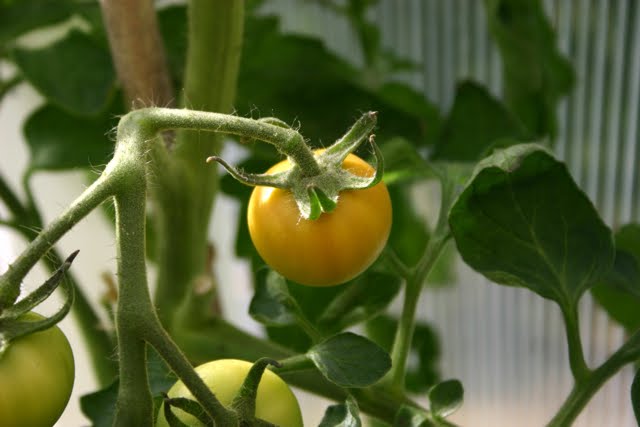
A little out of focus, but there it is - the first 'Jaune Flammée', and the third tomato harvested*. The skin was thick, and maybe it was a day or two too early (note the green tinges) - but it was delicious! Intense, sweet, fragrant, rich. The best reward, small though it is. Many more to come!

Another hungry gap! Usually, that phrase refers to the period at the beginning of the year, up to around April or May, when the overwintering veg (like cabbages and sprouting broccoli) is mostly harvested, and the spring stuff (peas, broad beans, potatoes, asparagus, salad leaves) isn't yet ready. Well, I've hit another one here in late July - but although it means my totals are well down right now, I can avoid it next year if I sow the right crops.

Simply put, the first flush of summer fruit and vegetables have been gathered and preserved or used. Meanwhile, the late summer harvest is still unripe. As I picked pretty much nothing in the first week, I decided to swap back to a fortnightly harvest update, but I'm hoping that I can revert to a weekly format soon. There were some things to be picked; spinach still provides - although I pulled up one plant that was being encroached by a lavender that's grown a lot since they were all planted in March, the remaining two are producing fairly tender flower spikes with small leaves that go nicely with pasta. The grape vines have grown rampantly for the most part (I need to control them at some point), which is excellent for stuffed vine leaves - something I made a lot of last year, but not as much as I wanted. The leaves are mostly a little smaller than I'd like, but it's not too hard to use two or three per roll. You can buy the leaves in specialist shops or some supermarkets, of course, but how much better to gather them from your own garden - so exotic for these climes. They are simply trimmed of their stalks, blanched in boiling water for a minute or so, and left to drain. Once you get the hang of wrapping them round rice (with various seasonings), or minced meat, or a combination of both, it's quite easy, and they have a lovely, distinctive, sharp taste from the tartaric acid they contain. Delicious.

The blackberries are early this year, like everything else. I left some to grow on an otherwise uncultivable patch of ground at the side of the back garden, but I will probably not leave them next year, as they always try to spread. I reclaimed much of the back from brambles over the past few years, but they are tenacious - they still sprout here and there (the trick is to dig them out, and keep attacking them whenever they appear). For now, though, the dark, soft, ripe fruit is very sweet, and ideal for a late batch of jam.

The highlight of this week, however, was the smallest harvest of all: the first tomatoes! The first of all was indoors, on the windowsill. The second was from a plant that had formed fruits similarly in response to stress, but that I'd planted up on the terrace, so it counted as the first outdoor tomato. Both were 'Gardener's Delight', a variety not known for being especially early, but which deals with adverse conditions better than most. The final one was 'Jaune Flammée', from the greenhouse plant that went in first. It has many fruits on several trusses, which are now taking on colour, but it's nearly five weeks late (based on the number of days this variety ought to take from final planting to harvest), so it's not perfect. Still, all were indescribably intensely flavoured and delicious, and the ultimate reward for all the work I've devoted to them so far. Just another 50-100kg would be nice now!

Totals for week 15th-31st July:
26th: 4g tomato
28th: 278g turnip tops, 35g shallot (day total: 313g)
30th: 3g tomato, 312g vine leaves**, 48g spinach, 478g blackberries*** (day total: 841g)
31st: 14g tomato, 72g spinach (day total: 86g)
Total for fortnight: 1.244kg
Total for July: 7.351kg
Year to date total: 18.942kg

Over a kilogramme isn't bad, I suppose, and I'm heading towards 20kg, which is another milestone. I just need more tomatoes to ripen! I'll continue to harvest vine leaves (another few in the coming week, probably, and then a second flush before they turn at the end of the summer) and blackberries - they ripen over a period of weeks. There are also saladings coming - a tray of mesclun (mixed leaves), and then the kailaan (which I've already potted on) and seedling thinnings. And more spinach I expect.

*In the last entry I asked of a tomato "how long before this is ready to pick?". This is the very same - so the answer is five days!
**I only include those from my garden; I will also harvest some from next door (my granddad's), but since I didn't grow them, they can't count towards the total.
***These grow unfettered on a strip between my garden and next door's fence. I didn't plant them, but allowed them to grow there, so I count them in my total.

Tuesday, 26 July 2011

Encouraging signs

I've never seen a marigold this colour before - it's lovely!

It's been good weather again. As if to remind us what the summer can be about, warm sunshine has beaten rain more often than not this past week, although the wind hasn't been insubstantial - even today, despite a forecast of a few miles per hour, I watched the washing bounce back and forth on the line. Not enough to discourage me from working outside though - and I need to, as some of that wind has damaged the roof of my new greenhouse (as I mentioned in the last post).

But pottering around the garden, although the overriding impression was of semi-wilderness, the weeds having reclaimed whichever corners I haven't spent much time in recently, there was a sense of impending fecundity. Wildlife thrives here, mostly because I've never stripped back all the wild plants, and hopefully also because I don't use pesticides. I found a common blue butterfly, which was unperturbed by me shoving a camera lens close to it. There were bees, hoverflies, and other unidentifiable insects (I find most very tough to name). The Calendula plants that I grew from seed and squeezed in wherever I could back in the spring are still flowering their heads off - all colours from pale peach and lemon to deep orange and gold. The grape vines on the terrace need controlling, but are growing rampantly - excellent news both for my plans for a vine-covered pergola, and for the batch of stuffed vine leaves I'm intending to make in the next few days.

The warm sunshine makes everything glow of course. And when the breeze isn't too strong (it's calmed down since this morning), the scent of Buddleia, lavender, and mint (in the front garden), and roses (in the back) fills the air, and adds to the sensual pleasure of the space. And there are flowers! The roses are having a better year than I can remember - older plants are thriving, and ones I put in last year look just as well established (I love roses, by the way - they are my absolute favourite ornamental plant, although they have a culinary use too, of course). Nasturtiums and Cosmos (grown from seed like the Calendula), and lavender are also in full bloom, although the garden isn't quite a riot of flowers.

But colour is appearing elsewhere. The runner beans have been flowering for a couple of weeks - but as yet, no pods have formed. This is a worry, as I've never had success with them in the past, either - so much for being an allegedly "easy" crop. I chose 'Painted Lady', which is the best variety according to several sources. At least its scarlet-and-white flowers are pretty - still, I'm not giving these plants space in future if I get no crop this time (it was really my fault last year, but this time I've put them in a large container, fed them, and given them very tall supports). The French beans have also started flowering - but today I saw a tiny pod, so some beans should be on the menu this year, at least. The colour I am most excited about, however, is - tomatoes! As if in response to my concerns the other day, some of them have started taking on colour at last - the final step in the long process. One 'Jaune Flammée' (though not the oldest or largest) has turned yellow-green, although it still feels hard. Up on the terrace, a 'Gardener's Delight' I stuck in one of the large planters (where the peas had been) has a single, tiny, bright red fruit (again, it didn't feel quite ripe, so I left it for now). I will harvest the first fruit today though - but indoors. The windowsill beat them all - though I'm going to compost all the remaining plants there (squash, aubergines, tomatoes, basil), as they have been baked, infested by greenfly, and neglected to the point of death anyway. I also need the space for all the autumn vegetables.

How long before this is bright orange and ready to pick?

This should be ready in a few days.

On which note, I have built a raised bed. I had two planks of sturdy, tanalised wood waiting to help reinforce the side fence, but I decided to put them to better use and make a rectangular frame to raise the soil level in the front garden a little. I was inspired by my friend, with the greenhouse tomatoes I envy, whose fiancé has built just such a raised bed in their back garden. They have a major horsetail infestation, and lined the bottom of the new bed with weed-suppressing membrane. I don't have any such fiesty weeds, but I do have problems with couch grass in the front. I was digging it out bit by bit, but this way is much quicker and should stop the grass coming back if I miss any of the roots. Well, we will see. I wanted to try out my new circular saw, so I cut the timbers at 45º so there were no cut ends facing outwards (which should retard rotting). I will staple the anti-weed fabric and then place it over a section of the front garden - I'll remove as many of the weeds as possible first, though. I have about 45 litres of homemade compost, to which I'll add a little sand and some sieved garden soil. I may add a second layer of timber, either this week or in a few months. At its current depth, I can grow leafy crops, turnips, beets, and kohl rabi, but probably not carrots or long radishes. Either way, it should push things forward a lot - the front garden will be mostly vegetables by the autumn, if all goes to plan.

Saturday, 23 July 2011

A feeling of unease

I didn't sleep well last night. Well, I didn't sleep at all - I only managed to drift off after dawn (announced by an hour of shrieking gulls - this is one of the noisiest times of year for them - it's like living in a bird sanctuary). I was running over all the things I hadn't done so far this year, all the plans that came to nothing, and worse, the plans I started and let fall away. The plants I neglected, the patches of weeds, the delayed crops.

One source of concern at the moment is the tomatoes. In the previous post, they must have sounded quite healthy - growing taller, setting fruit. But all is not well. The outdoor tomato plants are healthy - deep green, stocky, flowering. Many of the flowers, however, are taking an age to open, and many more that do aren't setting fruit. In the greenhouse, things are reversed - there are lots (dozens, even) fruits forming, but the plants do not look well. The largest, those planted way back in May, are worryingly spindly, etiolated things - all their leaves, save those they already had when they went in there, are curled back on themselves and tiny, the stems stretched out. Compared in particular to my friend's greenhouse tomatoes, from the same stock of plants, sown in the same way, at the same time, in the same place, are archetypal - whereas mine are downright sick looking.

I have looked into it. The first signs of leaf curling I feared were disease - but all the experts say, curling leaves are a sign of health, though possibly of cooler nights, but absolutely nothing to worry about. But now... it hasn't gone away, it's spread. I have watered them, fed them, cut off side shoots, tied them in. They are flowering, and fruiting, as I say, though the fruit is showing no sign at all of taking on colour. I got it into my head last night that maybe twinwall polycarbonate is unsuitable for greenhouses after all - I have made massive mistakes before - and they were to all intents and purposes growing in darkness (UV-darkness, anyway). But today, I consulted a range of sources, and all agree, it's an ideal material to build a greenhouse from. So I am left with the less expensive, but still worrying conclusion that they are diseased. I hope I get a crop from them - so far so good. But I won't settle until those spindly boughs are dripping with red, yellow, cream, green, and orange baubles. It seems I have a long, anxious wait ahead...

Can you see what I mean? These plants are now getting as tall as me, but they are terribly thin...

Friday, 22 July 2011

Tomato update: mid July

'Costoluto Fiorentino' continues to swell - living up to its name! (Costoluto means "ribbed")

Bad weather discouraged me from spending much time in the garden this week. We had terrible weather over the weekend - gales again, which nearly tore off the roof from the new greenhouse. I wish I didn't have to say that every few months, but it seems despite the buildings, walls, and fences that look as though they shelter the place, being so close to the coast means winds like that are a fact of life. At this rate I'm going to have to build my greenhouses out of steel. Anyway, I managed to save it, although a little repair is necessary. Meanwhile, the plentiful rain has kept the outdoor tomatoes green and vigorous, while those under cover are spindlier, but fruiting freely. Here's the standard rundown:

This is by no means the largest 'Jaune Flammée' fruit - just the easiest to photograph!

Black Cherry

planted 3 • largest plant 75cm flowers open fruit set ✔?

Cherokee Purple
planted 5 • largest plant 58cm tall flowers open fruit set

Costoluto Fiorentino
planted 6 • largest plant 112cm flowers open fruit set

Cream Sausage
planted 4 • largest plant 98cm flowers open fruit set

Gardener's Delight
planted 7 • largest plant 90cm tall flowers open fruit set

German Orange Strawberry
planted 3 • largest plant 44cm tall flowers open fruit set

Great White
planted 1 • largest plant 60cm tall flowers open fruit set

Green Zebra
planted 9 • largest plant 70cm flowers open fruit set

Jaune Flammée
planted 6 • largest plant 118cm tall flowers open ✔ fruit set

Riesentraube
planted 7 • largest plant 38cm flowers open ✔ • fruit set

Snowberry
planted 4 • largest plant 174cm tall flowers open fruit set

Sub Arctic Plenty
planted 4 • largest plant 60cm flowers open fruit set ✔?

Summer Cider
planted 4 • largest plant 100cm flowers open fruit set ✔

Sun Belle
planted 3 • largest plant 160cm tall flowers open fruit set

Super Marmande
planted 4 • largest plant 90cm tall flowers open fruit set

That makes 70 plants (I had aimed at 60, but I trust my notes, even though I don't remember planting quite that many). Some may have been left too late - although with the long days, mild temperatures, and frequent rain, it's possible they will have just enough time. As you can see, most of the varieties are now in fruit, and all but two ('Riesentraube' and 'German Orange Strawberry') are flowering. Again, it's amazing how much some of them have grown. 'Sun Belle' has grown 44cm - nearly a foot and a half - in 19 days. The largest 'Jaune Flammée', long since left behind in the height stakes, has fruit swelling on four trusses, and flowers open on two more. Other winners are 'Cherokee Purple', which is fast catching up the first planting. In fact, almost all the greenhouse plants now have baby fruit, demonstrating in an entirely unscientific way how much of a head start a bit of protection can give. The first ripe fruit goes to 'Gardener's Delight', and ironically it is on one of the plants that didn't get chosen - it's still in a small pot on the windowsill. That's the true sign of a tough, productive variety, I'd say - giving fruit in the least forgiving conditions. No sign of a sustained harvest this month, however. I live in hope.

'Sun Belle' is now fruiting freely in the greenhouse - little egg-shaped fruit on long trusses.

Sunday, 17 July 2011

Summer sowing

These kailaan seedlings are perfectly spaced

While these tsoi sim will need to be thinned out very soon.

I have too many seeds.

I didn't think I'd been too greedy buying them, but when they're all gathered in one place, it's frightening. So many varieties, so little space! I've learnt more about the best ways to sow and grow this year, with many failures due to lack of space/inconsistent watering/laziness. This second round of sowing should be more successful as a result. For instance, I've saved and washed as many plastic trays from food containers as I could, so all the pots will have their own reservoirs, and not dry out (or ruin the windowsill).

So what am I sowing? Well, I rediscovered a lot of seeds I'd bought reduced a few weeks ago, which are going to have to wait until next year as it's too late to sow them now. These are mostly flowers, so I'm not that bothered. However, July is a good time for many vegetables. I was going through them in my head, partly for myself, and partly for my friend, who now has a raised bed in her garden, and which would be a shame not to fill with edibles for the autumn. It struck me that all those you sow now are leaf, stem, and root crops. Those which were sown in the spring for summer/autumn cropping were fruit crops. It makes sense - it takes maybe half an annual plant's life to get to adulthood, then the same time again to flower and ripen its fruit. So the tomatoes started in March, and after four months are flowering freely. In another four months, they will have produced their whole crop, and died. Those vegetables that we don't want to flower (such as lettuces, spinach, root crops, and so on) can be cropped when they are much younger. It makes sense put like that, but I'd never seen it that way before.

With the exception of one or two oriental vegetables whose flowering shoots can be eaten (like a quicker version of sprouting broccoli), and broccoli itself (well, calabrese), all the current sowings are for leaves, roots, and stems. The quickest are baby leaf crops for salads. I sowed a tray of mesclun, a mix of salad leaves, over a week ago, and it's growing fast. At the same time I sowed namenia, which is a kind of mustard grown for its leaves. These germinated a day or two later, but are doing fine. Indoors this week, I've sown pots of mizuna, mibuna, mispoona (all similar, fast-growing, tender leaf crops), kailaan (which resembles broccoli in its uses), and komatsuna (akin to spinach, though again a type of mustard). Green and red perilla, the latter of which I grew very successfully last year, will add colour and spice (they are a pretty, nettle-like herb, much used in Japanese and Korean cooking). Yellow and green pak choi will provide bland, bulkier crops for stir fries - I've also read they can be dried for use in winter soups, which I find intriguing. Tsoi sim (or choy sum - there are many variant transliterations) is another leaf vegetable to add to the mix, along with 'Yukina Savoy', a sort-of loose-headed cabbage (though it may be a mustard, I'm getting confused by them all), and a true heading Chinese cabbage, 'Yuki' (what the Americans call "napa cabbage", I think). Meanwhile, mustard greens (which is to say, mustards without other confusing names), both red and green, will provide hotter leaves.

There are some western leaf crops, too. Summer spinach is tricky, but hopefully worth the effort. Perpetual spinach has proved itself tough, productive, and reliable, so I'll sow lots of that, but later in the year. Mixed chard (in various colours) should brighten the garden up, though I've never had big crops from them, especially the yellow-ribbed kind. Turnip greens 'Rapa Senza Testa' should be quick and easy (if a little coarse). Kale 'Nero di Toscana' (better known as cavolo nero) is a nice, tough, hearty leaf crop for the long term. For salads, I also have a heading lettuce 'Lakeland', which I don't think I've ever grown before - they seem a bit daunting in a garden with so many slugs and snails!

Roots and swollen stems will take a little longer to mature, but are less perishable and don't wilt down. I still have 'Snowball' turnip seed (the packet has lasted me a couple of years, and provided several excellent crops), and I bought a purple-shouldered variety to take over when they're gone ('Purple Top Milan'). To replace the failure carrot seeds I tried in spring, I've got a small, quick type 'Amsterdam 3 - Sprint', and a more standard kind, with the very encouraging name 'Autumn King 2' (I don't know why carrots seem always to have numbers in their names). Swede 'Collet vert' (green-shouldered) is a bit more of a gamble - I've never grown it before, so I don't know how easy it will be. Bulb fennel was a surprise success last autumn, and is so expensive to buy, it's worth growing a larger crop this time round (amazing how the tiny, feathery seedlings can bulk up so much by November). Kohl rabi 'Azur' (despite its name, it appears to be purple) should be straightforward, though the one time I did sow some (a different variety), they didn't germinate. Beetroots, both standard red, and 'Chioggia', which displays concentric red and white rings when cut open, will be sown direct, as the spring sowing into modules was an almost total failure. Radishes should be quicker. I have standard red and white summer radish 'Sparkler 3', although the seeds are getting a bit old. I have two pointy white varieties (I bought two by accident, I don't like radishes that much!), 'White Icicle' and 'White Dream'. Finally, and most unusually, I have German black winter radish, which are cooked, rather than eaten raw. They should be interesting! Even more exotic is "zha cai" (榨菜), a kind of mustard grown especially in Sichuan for its swollen, knobbly stems, and often pickled. I couldn't resist something so unusual! It shouldn't be any more difficult than any of the other varieties though.

And a few herbs. I have a load of different basil seeds, which I'll try and coax into fast production on the windowsills and in the greenhouse. There's also dill, fennel, parsley (I sowed this at the same time as the mesclun, but it's been slow to sprout), lovage, and sage - which I find a little more daunting, being a perennial.

How many varieties is that, then? Maybe 50? Too many, perhaps. But I won't go hungry, at least in theory!

What to do with raspberries (part 2)

Once again, I started this a while ago, when there was still a plentiful supply of fruit coming from the garden. Ten days later, I've finally completed it, but the fruit is gone...

Two bottles of raspberry vinegar (for recipe see part 1); on the right, last year's, made from white wine vinegar, now mature; on the left, white balsamic vinegar just beginning to take on the fruit's colour and aroma.

The raspberry glut continues, so I've been searching out more ways of dealing with them. I have started freezing the best ones, in order to prevent them mouldering around my kitchen (at one point, I had a good dozen bowls and colanders full of soft fruit, and it was getting difficult to prevent some going off), and I've made more jam, but there are other ways of preserving their deliciousness...

On July 4th, my friends had a small barbecue. It was the best weather - mostly sunny, really warm (for round here - low 20s), and mild right into the night. As an American was present, I decided to make a red, white, and blue dessert. Originally, I was going to try pavlova, but I had a lot to do, and wasn't inclined to spend several hours on it. The next best thing was Eton mess - incorporating homegrown strawberries and raspberries. I consulted a few recipes online, and adapted them to what I had in. First I whipped double cream with a good drizzle of honey and a dash of vanilla extract. Into this I crumbled shop-bought meringues. Then I took a bowlful each of raspberries and strawberries. half of these were puréed with a hand blender with a drizzle of balsamic vinegar, the passed through a sieve to make a coulis. The final dessert was assembled by stirring the intact fruit (the strawberries were chopped), with a punnet of blueberries, through the cream-meringue mixture, then drizzling the coulis over the top.

The reason I had the cream was a recipe I found in Rick Stein's French Odyssey cookbook for raspberry parfait. Sadly, I never got round to making it. However, for the record, it's a frozen dessert made by whisking eggs yolks and sugar syrup, then adding whipped vanilla cream, crushed raspberries, and freezing in ramekins. They are served topped with fresh raspberries and icing sugar.

Now for something experimental. I developed a love for pomegranate molasses over the winter. I'd never tried it, so when I visited a great Middle Eastern/Turkish/Greek/everything food store in south London in November, I had to get some. It's not cheap, but it goes a long way. It's almost transcendentally intense - sweet and sour together. I like it as it is, but drizzled over roast meat, stirred through cous cous, or added to sparkling wine, it's just as good. I want to make my own sometime, although pomegranates are criminally expensive (as is their juice). However, for now, I'm trying raspberry molasses. I could find no recipes for this online, so I went with instinct. I had a colander of raspberries that were on the turn, so I crushed them, then strained them through muslin with boiling water. I poured the juice into a pan, and added a little white sugar. This was brought to the boil, then simmered very gently, and allowed to reduce until syrupy. I didn't want it to be too sweet, so I kept tasting, to make sure it was balanced (citric acid is useful here, in case you do add too much sugar). The idea was partly to make something unusual, and partly inspired by how quickly the strawberry syrup I made a few weeks ago went mouldy (the liquid under the surface is still fine). A "molasses", being that much more concentrated, will, in theory, keep indefinitely. As for uses, I'm hoping it will work wherever the more usual version is recommended!

A extension of the fruit syrup in the last post on raspberries is the alcoholic version: raspberry liqueur. Essentially, this is a syrup or cordial combined with a spirit. It can keep much longer than the non-alcoholic version, depending on strength. The simplest method is to make a syrup and then combine it with brandy, vodka, or rum. However, I would recommend making the syrup more concentrated, with higher sugar and acidity levels (adjusting with citric acid), in order to counterbalance the alcoholic "burn". Another way of making them is to layer the fruit with sugar in a large jar, topping up with the spirit of your choice. However, it's much harder to balance the flavour, as it takes up to several weeks for the sugar to dissolve, and the fruit juices to seep into the liquor. The method I'm using this time is more complicated than either of these, and based loosely on the recipe for Chambord, a proprietary "black raspberry" liqueur (there are a couple of species of fruit called black raspberries, but I'm not aware of which, if any, is used for this - it has always sounded rather like something dreamed up by their marketing department, especially given neither type of raspberry is native to Europe, yet the liqueur claims 17th century ancestry). The Wikipedia article outlines the method, but it basically involves steeping the fruit in brandy and then pressing. I have started the process, with the addition of a little sugar. The fruit will be left for a couple of weeks, then passed through a sieve, and strained through muslin, before adjusting for taste. This leads to a much stronger liqueur than the first method above, since no water is added to the mix.

Raspberries soaking in brandy. The bits will be strained out before final bottling.

Flavoured spirits were rare a couple of decades ago, but you can buy dozens of kinds nowadays - mostly vodka. It's still worth making your own, however, since you can produce flavours that are unavailable, it works out cheaper (in general), and they tend to taste fresher and less confected (at least to me). Vodka is a clean, neutral base, perfect for any fresh fruit, vanilla, or more exotic things like chilli, ginger, or horseradish. Rum and brandy work with most fruits too, and also spices and dried fruit like raisins and sultanas. Gin is usually paired with the autumn hedgerow fruits damsons and sloes, although summer fruits might be worth a try too. In all these cases, the method is the same: either pour out some of the spirit from its original bottle (assuming it doesn't have one of those pesky plastic contraptions that restrict the flow) and fill with your flavouring of choice, topping up if necessary. Alternatively, place your flavouring into a wide-mouthed jar, and fill up with the spirit. Leave in a cool, dark place for a couple of weeks or several months, shaking regularly. Either strain and return to the bottle, or use as is, although it will need straining before use in cocktails or with a mixer. It goes without saying your flavoured spirit will take on the colour of whatever you've soaked in it - rather than remaining colourless like the commercial versions. If you've made raspberry vodka, try a raspberry martini: shake 2 measures (50ml) raspberry vodka with 1 measure each of sugar syrup (or raspberry syrup, or honey) and either lemon or lime juice. Strain into a chilled martini glass. A measure of fresh raspberry purée would work in this too. Or try a raspberry Collins: stir 2 measures raspberry vodka (or gin), and 1 each of syrup and lemon juice, with ice in a tall glass, and top up with soda water.

(For another cocktail using raspberries, see this previous post).

A raspberry martini - very intense! (Apologies for the use of flash)

No doubt there are plenty of other things you can do with these delicious fruits, but I think that will do for this year.

Thursday, 14 July 2011

July harvest: week two

Shallots, laid out in the sun to "cure"

It had to happen, though when it came, it was more sudden than I expected: the end of the soft fruit harvest. I lost a fair amount to laziness - some shrivelled berries dropped to the ground, some were too far gone to use. But most - well over 75% - have been harvested, I'd say, and I don't begrudge the earth taking back some of what it gave me. There was far more than I needed anyway.

The sun has shone rather a lot in the past couple of weeks. The temperatures have been pleasant, the wind light. Evenings and nights have been cool, which may suit some plants more than others. In general, it's a "normal" English summer I suppose - though it's been so long since we had one (last year there was a hosepipe ban here, the last few years have seen prolonged heavy rain), it's hard to tell. I suppose what I mean is this is what I hope for in the summer - it's not Mediterranean, let alone subtropical, but it's nice. Ideal for spending time outside, which encourages me to tend to plants, pull up weeds, and do general building work and maintenance, which I might otherwise neglect.

For the first time in weeks, the harvest is dominated by vegetables again. Just as the broad beans were a blip when they finally matured, so this time it is with the shallots. I had two varieties, in three locations - "Red Sun" and "Golden Gourmet". They were purchased on a whim, reduced, from Wilkinson (a general store, very useful for those of us in the town centre without a car, as they sell lots of gardening and DIY products). They cost around £1.30 a bag, with 40-50 sets in each one. I had a main bed, on the lower part of the sloped part of the back garden (around 2 metres by half a metre), in an old recycling box, and in the front, in a corner. The main bed thrived, the box shallots have done okay, but are quite small, and those in the front got overshadowed by weeds and other vegetables, and have shrivelled, though survived. This week I picked all the main bed, and acidentally pulled up one cluster in the front. They range in size from similar to a clove of garlic, up to the size of a golfball, though most are about halfway between these two extremes. The main bed yielded a large weight (see below), which for reference is about 125-130 separate bulbs. I am really impressed by that - they were cheap, easy, and I only fed them once, at the start, by enriching the soil with a little compost, and a sprinkling of blood, fish, and bone. They were not watered after the initial planting. So they epitomise the ideal small garden crop: low-maintenance, cheap, and providing a large crop in a small space. They will be a fixture in my garden forever more.

Totals for week 8th-14th July:
10th: 461g raspberries*, 21g spinach (day total: 482g)
11th: 50g shallots
13th: 2.574kg shallots**, 84g strawberries, 16g blackcurrants, 367g raspberries (day total: 3.041kg)
14th: 12g beetroot, 31g beetroot tops, 59g turnip (day total: 102g)
Total for week: 3.675kg
Year to date total: 17.698kg

As you can see, I beat my informal target this week, which was 16.5kg. I must say, I'm becoming rather blasé about it - but I ought to remember how ecstatic I was with a few tens of grammes per week back in the spring. July to October is the heavy cropping season, of course, when the garden has the most sunshine to convert into produce, and where the work of the spring bears literal fruit. However, this is also a time to be planning for the next six to nine months - as there is a great deal that can be sown into the spaces left by beans, peas, and shallots.

So what's the plan? Well, the tomatoes and summer beans are mostly self-sufficient, needing just occasional tying in, pinching out, feeding, watering, and inspecting. Pleasant tasks, especially in the summer sunshine. What really needs my attention is sowing and preparing ground. At this time of year, seeds germinate very quickly - in days in many cases - so it won't be long before fresh greenery appears around the place, which mitigates a little the feeling of sadness as the summer turns into autumn.

A few conventional British crops can be sown now, just: beetroots, summer spinach, spring onions, radish, and lettuces, and even late peas. I'll try to make room for all those, but I'm really concentrating on "oriental vegetables", of which a great range is now available, and which have the advantages of varying hardiness (so some will go right through the winter, especially under cover), novelty (shapes, flavours, and textures that will liven up the garden and the kitchen), and speed (some will be ready in four to six weeks). I've got pak choi, tsoi sim (choy sum), kailaan, komatsuna, mustard greens, mizuna, mibuna, mispoona, and a few more whose names I haven't yet learned. And a few random crops: amaranth, orach, kohl rabi, radicchio, and black winter radish. Making room for all of these will be a challenge, but I will be creative. If all goes to plan, September and October will be fruitful times indeed!

*includes 100g estimate, fruit I picked and immediately gave to my granddad without weighing.
**picked 11th, left to cure in the sun until the 13th, when they were cleaned and weighed.