Showing posts with label gardening. Show all posts
Monday, 2 April 2012
The "allotment" three weeks in
Has it only been three weeks? It seems a lot more, especially seeing how much my friends' garden has come on. I hadn't been for a fortnight, in fact, because I was too busy at home. But yesterday was the last of a long line of unseasonably warm, sunny days, so I headed over to see what was afoot.
Aside from helping to paint a fence (that will hopefully be clad in sweet peas this summer), I checked on the progress of the seeds we'd sown, and took a few photographs.
The most pleasing sight was seeing the outdoor seedlings had germinated. Two rows each of spinach 'Medania', beetroot 'Boltardy', and carrots 'Amsterdam 3 - sprint' were all visible, the spinach quite large and the carrots tiny. I thinned the first two, leaving about 50% - further thinning will take place in a few weeks, as the plants get bigger. The carrots I left, partly because they were so small, and partly to avoid releasing any scent that might attract carrot root fly. The catch-crop radishes I sowed a few days after the main crops here were showing no signs of life - but they were old seeds.
The tray of pak choi I sowed just over two weeks ago was full of large seedlings, already getting their true leaves. The difference in colour between the two varieties, 'Green boy' (green) and 'Santoh' (yellow) was apparent. I spent a pleasant 10 minutes thinning these to around half their number too. I had sown them thickly, not knowing how good the germination would be, but even so, we will have far more than we need - which is never a bad thing.
A few things in the greenhouse looked forlorn, because of the recent heatwave. Some radishes 'White icicle' had been scorched, and the onions were dry - but they should come to no harm. They were ready for planting out, so I soaked them, then packed the fourth quarter of the first raised bed with as many as I could, and the rest went into the second, shadier bed. I planted them close, since we don't have endless space - perhaps too close, but I'll see they are well fed and watered. Whether they sulk in the shadier, east-facing bed, remains to be seen. Altogether, there were over 40 plants.
Elsewhere, two trays of mixed salad leaves aren't far off their first harvest trim, and a tray of mispoona (a mizuna-like oriental leaf) sowed a few days later is also lush with growth. The basil and sweet peas are germinating, but small. A period of much cooler weather is upon us, so hopefully the greenhouse plants will get some respite - but it's been a foretaste of the potential heat of the summer (in the greenhouse at least), so perhaps a drip-watering system will be worth setting up after all.
Thursday, 15 March 2012
The time is now
Although in practice, growing and cooking takes place throughout the year (especially if you have a greenhouse or polytunnel, and a level of self-discipline), I tend to think of there being two pivotal times - almost six months apart. August-September is the high season for harvests - most things are ripening then. We are now entering the other - March-April is when the vast majority of crops are (or at least can) be sown, when the first hardy vegetables and flowers are planted outside, and when the natural world provides a great range of wild foods to make up for the garden's dearth (on which more in a future post).
Organisation is paramount. Every day's work now is worth a week later, or there abouts. The lengthening daylight, increasing air and soil temperatures, slightly lower rainfall than autumn and winter, and the end of the frosts* all encourage seeds to sprout fast, and grow well. That means both that you need a lot of pots and compost, trays and windowsill or greenhouse space to fit your sowings, and time and energy to fight the weeds - because they will respond to the improving conditions even better. Clearing brambles now, just as they are coming into bud, is a lot easier than in a couple of months, when their new growth may be half a metre long and they are covered in leaves. Hoeing soil encourages weeds to germinate, and re-hoeing when they have done so will destroy them and reduce the problem considerably - though weeds tend to have seeds that vary a lot in how long they are dormant, and how responsive to disturbance, another reason they are so persistent, so it won't eradicate them entirely.
On that note, I am tackling both sides at the moment. I'm trying to sow a few crops every day or two, which makes it seem a lot less work, and sets up a conveyor belt, with the larger plants able to move from the germination station (a bright daylight lamp by the fire) and onto the windowsills or outside. Three days ago I sowed scorzonera 'Duplex' (a black root vegetable), herb (as opposed to bulb) fennel, namenia (a leafy salad crop), green perilla, and broccoli 'Autumn green calabrese'. The next priority is other herbs - especially basil, parsley, chervil, sage, thyme - lettuces, onions, and annual flowers.
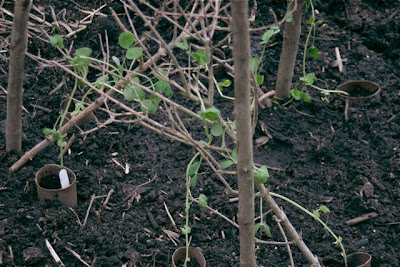
Outside, I've started hardening off the first legumes I started soaking 6 weeks ago. They went from indoors proper (warm), to a cool spot by the front door for a couple of days, to the front step, which is sheltered but at the ambient outdoor temperature. They've thrived, and the first six purple-podded peas went into the front garden earlier this week. The broad beans - six 'Aquadulce longpod' and around 8 of an unknown variety that I bought as dried pulses from a local shop, are around 30cm tall, and will go in soon. Potatoes, which have sprouted nicely ('Red Duke of York' I think, though I've misplaced the label) have been put into four large planting bags - two tubers each. Plants I don't want - like red valerian (Centranthus ruber), which I like but find rather invasive; couch grass; dandelions and the like - are just sprouting, and have been fairly easily removed (though they will return).
The grow bags I grew most of my tomatoes in last year are spent, but they will be useful as a soil conditioner and mulch - they are largely free of weed seeds, and full of worms, and although most of their nutrients will have been exhausted, they raise the soil level, lighten its texture, and I am adding nutrition back in by sprinkling blood, fish, and bonemeal, and adding homemade compost.
There's a fair amount of sorting and shifting to do. The two raised beds I built last year became infested with couch grass despite weed-suppressant fabric underneath - the grass just pushed through. I've removed the soil, added a second layer of fabric, and fresh compost. The old soil will be thoroughly sieved and likely rested somewhere for a few months, to prevent the spread of this most pernicious weed (if it resprouts, I'll attack it until it's too weakened to return). I've enough materials for one more bed, and enough room for another, albeit odd-shaped one in the front - that gives me enough space for some peas and beans, garlic, and chard, with gaps around for perennials and ornamentals - rosemary, lavender, alliums, and later marigolds, nasturtium, and cosmos.
Yesterday, I started on the back garden. It's been hanging over me, but once I scouted round I thought about it, I realised the situation is quite manageable. I cleared out the fire pit/barbecue, and lit it, as I've lots of prunings and dry material that is best burned. Over a few hours, I disposed of lots of buddleia, raspberry, privet, brambles, grass, tomato plants, and calendula - all essentially brushwood - and the old willow hurdles that surrounded two large planters, that after two years have become too brittle to keep. They all burned well, and will provide nice sweet ash for nourishing fruit plants and root vegetables in particular.
These sturdy bags have been part filled with compost, and planted with two chitted seed potatoes each. I'll top them up with more compost as they grow. There are four altogether, and I may get a few more yet.I gathered intact plastic pots and trays, that had blown hither and thither, for cleaning and reuse. Plastic waste (mostly pop bottles and plastic cups used in last year's sowing and watering) can be recycled. Other stuff will be thrown away (polystyrene, plastic bags that have blown in, that sort of thing). Pernicious weeds will go to municipal composting, benign stuff will be rotted down here. After that, a bit of sweeping and pruning, and I can set to fixing the broken greenhouses, relaying the terrace, painting, and the like. A fair amount of work, but nothing I've not done before.
Incidentally, a great deal has survived the winter - tulips, lemon balm, even a tray of mixed salad leaves. And life is returning - birds, ladybirds and seedlings abound (mostly unwanted in the latter case). Spring is a good time.
*Admittedly I am writing this from the perspective of my own garden. Here by the sea, there are few frosts in April (none last year) and almost none in May - although traditional gardening wisdom cautions they may occur as late as June, in my experience this is almost unheard of, especially nowadays.
Sunday, 11 March 2012
In lieu of an allotment
It's definitely spring - the frogs are swarming through my friends' (and their neighbours') garden, and there's plenty of spawn. Frogs can be startling when disturbed, but are useful for keeping down numbers of slugs and snails.Last October, the waiting list for the allotment site I visited in August stood with person #19 at the top - I am #45. As of just now, nothing has changed. That's pretty galling - that there has been no movement in nearly half a year. I don't expect to be around here for long enough to get even close to the top of the list - which is a shame, because the site is really lovely.
But a couple of years ago, before I ever considered such a formal move, I had another idea. My friend, who I helped with tomatoes last summer, has a large (classic, metal-framed, glass) greenhouse, and a long garden, in which she and her fiancé have started carving a garden - including raised beds. It crossed my mind I could make use of some of the space - they like the idea of a garden, but are very busy and not totally sure about what to do. But I pushed it from my mind - they live far enough away that I might not have been assiduous in visiting, and a garden needs discipline. And last year, they made some effort of their own accord - I gave them plants, and a little advice, but let them see how it went for themselves.
However, I decided to make my suggestion a week ago, partly because I know they had an imperfect time last summer. It was a bad year for tomatoes, and although their chillies and runner beans thrived, I don't think they felt terribly spurred on by the experience. Surprisingly, they were very keen, so I've effectively doubled my planting space. So here's the plan:
I sent them a list of the seeds I have. They picked what they most wanted to grow and eat. That's the core of the planting - because it's their space, and because it will hopefully encourage them if they can pick what they enjoy eating. Most of what they wanted can go in now - beetroot, spinach, carrots, onions, salad leaves, radishes - and the rest (such as squash) can follow on in two or three months. The idea occurred that, in the time before the tomatoes and peppers go in their final positions (we have both sown some, and can share plants and varieties, in case either of us suffers unexpected setbacks), I can sow some pots of spinach, carrots, and beetroot in the greenhouse to get a faster crop - perhaps a couple of weeks to a month earlier than the outdoor crops.
I went over today, to check out the space (it's been a few months), and get started. We made excellent progress - all the crops were sown, except the 'forced' roots and leaves, which I'll set to next weekend. We also got in some sweet peas, basil, and yet another variety of tomato, seeds of which my friend had lying around. I had bought some onion sets last week, and those went into modules to start off, ready for planting outdoors in a week or two. I also helped clear some of the perennial weeds.
Fresh sowings. In a week, the first shoots should have emerged - even on a resolutely cloudy day like today, the greenhouse was much warmer than outdoors.
The raised bed. My friends may build more, but for now, this is the centre of outdoor planting. We divided it into four, sowing three sections with two rows each of carrots 'Amsterdam 3 sprint', spinach 'Medania', and beetroot 'Boltardy'; the fourth will be planted with onions.
At the centre here is a bed of blackcurrants - they give a crop every year, but are swamped by brambles and what my friend describes as 'grass', although I suspect it may be a member of the lily family. [Edit: it's actually pendulous sedge Carex pendula, a native British plant related to grasses].
After a concerted attack with a sturdy knife and secateurs, I've made some headway - I'll continue on my next visit.Having a second garden to tend to has already encouraged me to do some work in mine - I'm hoping I'll learn a bit of discipline this year, something I could use a lot more of.
Saturday, 18 February 2012
New life
I mustn't let things slip here too much - I have a backlog of articles again! To keep things ticking over, this is a quick photographic update on my seedlings.
When chillies, aubergines, and tomatoes germinate, they emerge as a little thread like this, straightening out after a few days.
I tend to pre-soak large seeds, like sweetcorn, peas, and beans. It's useful for older seeds especially, allowing you to see which are viable and which are dead. These have been neglected though - their main root has withered, but they should recover.
When chillies, aubergines, and tomatoes germinate, they emerge as a little thread like this, straightening out after a few days.
I tend to pre-soak large seeds, like sweetcorn, peas, and beans. It's useful for older seeds especially, allowing you to see which are viable and which are dead. These have been neglected though - their main root has withered, but they should recover.Tuesday, 17 January 2012
Triple cherry smoked fruit beer / My cherry trees
I have a bit of malt left over from my first major brewing project, and I've been playing around with an online calculator to decide what to do with it.
I've also been enjoying a great blog on the subject of brewing unusual beers (and other food subjects), which inspired me to be a bit more adventurous - although there is something to be said about starting with simple recipes and working your way up, I tend to make what sounds interesting, even if that steepens the learning curve.
I have a thing for smoked beers - at least in theory. I have only tried one, on one occasion (the classic Schlenkerla Rauchbier, at my favourite Mancunian bar, Font). It sure was smoky, which isn't something you'd want in every drink, but it was interesting and not unpleasant. The way smoked beers are made is by smoking some of the malt, often over beech - although any wood you use for smoking food could work. You can buy ready-smoked malt, but since this recipe is made from leftovers, I'm going to smoke my own, using some of the many wood chips I bought last year for barbecues and smoking homemade bacon and suchlike.
I also love fruit beers, especially the two classics, kriek (cherry) and framboise (raspberry). I grow both in my garden - last year I got a single cherry and more than seven kilos of raspberries, but I wasn't brewing, so I used them in other things. I veer towards kriek partly because cherries seem much more luxurious, and partly because those I've had tend to be a little more sophisticated than other fruit beers. It happens that I have a bag of cherry wood chips, so I thought - why not combine the two? I came up with:
Triple cherry smoked fruit beer
for 4.5 litres (one demijohn)
grains and sugars
690g Maris Otter
280g English crystal
150g Amber, smoked over cherry wood chips
100g unrefined cane sugar
70g rolled oats
hops
2g Warrior (18.2% AA)
yeast
Hefeweizen (an unfiltered German beer, I poured some into a jug, added water and sugar, and let the yeast grow)/Wyeast Ringwood*
extras
toasted cherry wood chips
cherries
method
I'll mash the grains in the same way as for my first beer - namely by putting them into a big pan with water (I set my variable kettle to 80ºC, which comes down to the right range, 60-65ºC when mixed with the cold malt), then put that in the oven at a little under 70ºC for an hour. I'll boil with the hops for just half an hour - to extract the level of bitterness I've calculated, which should be pretty low, as what I've read suggests high hop levels and fruit don't combine well. I'll ferment in a glass demijohn with an airlock, and when it's done, I'll transfer to another demijohn, and add the wood chips. When the cherries are ripe, around midsummer, I'll transfer again, adding the fruit and probably removing the wood, depending on how woody it's become. The beer will sit on the fruit until autumn sometime, then I'll bottle it. The total time will be at least 9 months.
I really hope that I can use homegrown cherries in this - my schedule is based roughly around when they're ready. I can't count on having enough, or even any - as I'll explain below. In any case, that gives it five months or so on the wood chips - although I'll check to make sure it doesn't become unpleasant-tasting. Otherwise, I'll buy some fresh cherries around midsummer, and add those. As for quantities, I have no idea - but probably 20-30g of wood chips, and 0.5-1kg fruit.
What it ends up tasting like is unknown - I've never had anything like this, and it's rather experimental. But I'm using stuff I already have, so it's not costing me anything. If it's good, I'll have created something really exciting. If not - I now know you can blend beers, so maybe it won't have to be poured away.
*The Hefeweizen showed no signs of activity after a few days, so I added a little of my previous batch of beer, which is fermenting with Ringwood. Hopefully it'll take off soon. Update 25/1 - it's taken off now, bubbling contentedly (but not violently).
Update: 3rd February 2012
Fermentation has finished after ten days. The beer has been transferred to a fresh sterilised demijohn, and 35g toasted cherry wood chips will be added. Gravity measured at 1.015, giving a current abv of over 6% (the accuracy of a hydrometer is not really good enough to give fractions of a percent). Almost no sediment was transferred - a clean racking. Tasting of 80ml used for measuring the gravity: thick body, very little carbonation left. Copper-orange, good taste - I've had many worse beers in the pub. But there's no detectable smoke taste.
My cherry trees
I love fruit trees. They are amongst the most ornamental plants, with gorgeous (often scented) blossom announcing spring, summer verdancy and swelling fruits, edible baubles at harvest time, then bright autumn foliage. They don't need to take up much space - either get a dwarfing variety, or prune them into step-overs, cordons, fans, etc.
Even in my tiny garden, I've squeezed two cherry trees (and a quince). The cherries were from Tesco of all places, and bought on a whim - but I've always hankered after an orchard, so it wasn't unprecedented (I also bought a plum, but it didn't survive). I put one against the fence at the back of the garden - a position in full sun year-round, which gets very warm in spring and summer; the other went in on the other side of the terrace, about twenty feet away, and was left freestanding. I pruned the fence tree into a fan shape, which was held in place with canes. Perhaps because it has been constrained, the branches have grown much longer than the other tree - or perhaps it's the position, or variety.
Freshly-planted in spring 2009, the future fan-trained cherry had just three or four flowers - but put on strong growth through the summer.
In the second year, I added a framework of canes to train the branches into a fan shape. Plenty of blossom, but no fruit.
At the start of its third year, the fan shape was well established - it measured around 7 feet tall by 8 feet wide.
There was plenty of blossom in the spring of 2011, but just a single fruit ripened - most dropped, and the rest were probably eaten by birds (this year I'll put up a net).Monday, 9 January 2012
Chillies: the plan
I've written at length on the many tomatoes I've grown and will be growing, but this year there are other plans (and plants). Chillies are something I've had mixed experiences with in the past; shop-bought plants often thrive, even outdoors - so long as they get lots of sunshine and adequate watering. In fact, you treat them rather like their close relatives tomatoes (and aubergines), in that they are hungry, thirsty, heat-loving plants, but they seem less prone to disease. From seed, however, I've never succeeded, in part because I haven't been careful enough. Last year I concentrated on tomatoes to the detriment of their kin, which I left lingering as seedlings until they gave up, so this time I'm sowing them earlier - also because chillies seem to be much slower to germinate and grow.
There are many advantages to growing chillies. The plants are small, tending to grow to a fixed size, small bushes at most. This means they need no pruning and little support. The fruits aren't juicy, so they need less water and cope better with drought. Many of their fruits are small, but intensely-flavoured, so you can easily grow enough for your needs - whereas self-sufficiency in most crops is beyond the home grower with an small garden, it's not at all unrealistic in this case. Finally, they can be overwintered - at the very least, the fruits will keep well on the plant, even if it dies, and you might get a second flush the following year (in fact, all these plants are perennials in their homeland).
So here are the varieties I'm going to try. Apologies for poor-quality photos; there aren't many available. The heat ratings (﹆﹆﹆, ﹅﹆﹆, ﹅﹅﹆, ﹅﹅﹅ for no heat, mild, medium, and hot respectively) and other info are from The Chileman, an excellent online resource on the subject:
Black Hungarian ﹅﹅﹆
photo: conalloughry
Attractive Hungarian heirloom variety, with red-to-deepest-purple fruits, and purple flowers. Good flavour.
Chocolate beauty ﹆﹆﹆
photo: Gelatobaby
A dark bell pepper, no heat. An F1 (breaking my normal rules, but I didn't know this when I bought the seeds) with deep-red-to-dark-brown, large fruits.
Corno di toro rosso ﹆﹆﹆

Long, often curved, horn-shaped sweet fruits from Italy. Like the long bell peppers sold in supermarkets, I'm hoping, perfect for stuffing with goat cheese.
Costeno amarillo ﹅﹅﹆

Medium-sized, narrow golden fruits, thin-fleshed with complex aroma, used in yellow mole (Mexican chilli) stews.
Habanero mustard ﹅﹅﹅+

Rare; peach-coloured, warped, blunt fruits, extremely hot.
Hungarian yellow wax ﹅﹅﹆

Long, pointed, Hungarian variety, ripening to orange or red, but harvested unripe when pale yellow-green. Good for pickling.
Onza ﹅﹅﹆?

Could be one of two varieties, either Mexican or Italian (I think it more likely I'm growing the Mexican one). Either way, little information is available.
Red cherry ﹅﹆﹆
photo: Scott Hamlin
A number of similar varieties exist; probably mild, small, round, red fruits. Varying heat. Good for pickling or stuffing with cheese.
I'll post an update once they've started growing.
There are many advantages to growing chillies. The plants are small, tending to grow to a fixed size, small bushes at most. This means they need no pruning and little support. The fruits aren't juicy, so they need less water and cope better with drought. Many of their fruits are small, but intensely-flavoured, so you can easily grow enough for your needs - whereas self-sufficiency in most crops is beyond the home grower with an small garden, it's not at all unrealistic in this case. Finally, they can be overwintered - at the very least, the fruits will keep well on the plant, even if it dies, and you might get a second flush the following year (in fact, all these plants are perennials in their homeland).
So here are the varieties I'm going to try. Apologies for poor-quality photos; there aren't many available. The heat ratings (﹆﹆﹆, ﹅﹆﹆, ﹅﹅﹆, ﹅﹅﹅ for no heat, mild, medium, and hot respectively) and other info are from The Chileman, an excellent online resource on the subject:
Black Hungarian ﹅﹅﹆
photo: conalloughryAttractive Hungarian heirloom variety, with red-to-deepest-purple fruits, and purple flowers. Good flavour.
Chocolate beauty ﹆﹆﹆
photo: GelatobabyA dark bell pepper, no heat. An F1 (breaking my normal rules, but I didn't know this when I bought the seeds) with deep-red-to-dark-brown, large fruits.
Corno di toro rosso ﹆﹆﹆

Long, often curved, horn-shaped sweet fruits from Italy. Like the long bell peppers sold in supermarkets, I'm hoping, perfect for stuffing with goat cheese.
Costeno amarillo ﹅﹅﹆

Medium-sized, narrow golden fruits, thin-fleshed with complex aroma, used in yellow mole (Mexican chilli) stews.
Habanero mustard ﹅﹅﹅+
Rare; peach-coloured, warped, blunt fruits, extremely hot.
Hungarian yellow wax ﹅﹅﹆

Long, pointed, Hungarian variety, ripening to orange or red, but harvested unripe when pale yellow-green. Good for pickling.
Onza ﹅﹅﹆?

Could be one of two varieties, either Mexican or Italian (I think it more likely I'm growing the Mexican one). Either way, little information is available.
Red cherry ﹅﹆﹆
photo: Scott HamlinA number of similar varieties exist; probably mild, small, round, red fruits. Varying heat. Good for pickling or stuffing with cheese.
I'll post an update once they've started growing.
Monday, 24 October 2011
October harvest: week three
I started clearing the last of the tomatoes. I picked all the remaining fruit in the front garden first, and pulled up the plants from the ground, gathering those in grow bags together, ready to be taken round to the compost bins. A couple of days later, I stripped all the fruits from half the varieties in the back garden, and the rest I'll do in the next couple of days (I did it that way so I didn't get confused between similar-looking varieties, given they're mostly all green).
I also picked the first stem lettuce (celtuce). I was impressed - it was exactly what I was expecting. It turns out I planted them too close together - they were tiny when I put them in, but they swelled and are pressed together now they're getting mature. But they are perfectly healthy, and that's really encouraged me for next year - the oriental greens can be sown early in the spring as well as after midsummer. I need to harvest the rest of them soon, because I don't think they are frost hardy (and I need the space for other crops). I prepared the first one by discarding the lower leaves, then taking off the upper ones, washing and chopping, peeling the stem, and chopping that into matchsticks. I stir fried it with lime juice, fish sauce, and Shaoxing wine, and sprinkled with (shichimi) tōgarashi (Japanese seven spice). Despite being a mature lettuce, it was very mild with almost no bitterness.
Totals for week 15th-21st October:
19th: 205g stem lettuce (comprising 88g stem and 117g leaves), 1.984kg tomatoes (comprising 22 'Risentraube' at 130g, 63 'Jaune flammée' at 1.185kg, 1 'Super marmande' at 24g, 1 'Cherokee purple' at 171g, 6 'Costoluto fiorentino' at 140g, 7 'Sub arctic plenty' at 176g, and 19 'Cream sausage' at 158g; day total: 2.189kg)
21st: 137g baby pumpkins, 293g 'Uchiki kuri' pumpkins (largest 153g), 1.434kg tomatoes (comprising 7 'Snowberry' at 32g, 15 'Costoluto fiorentino' at 821g, 18 'Jaune flammée' at 306g, 67 'Sun belle' at 275g; day total: 1.864kg)
Total for week: 4.053kg
Year to date total: 37.891kg
The pumpkins were a writeoff. Of the two plants that I got into final positions (out of several dozen sown into pots), one produced nothing, and the other didn't have time once it had recovered from snail attacks to produce full-sized fruit. The baby fruits I took from a vine that grew of its own accord from homemade compost. It germinated in July, I think, but has spread along the whole depth of the front garden - I'll measure it before I pull it up. Sadly, the fruits were bitter. Squash cross-fertilise easily, so if you plant seeds you've saved (or allow seeds to germinate from home-grown or shop-bought fruit), they might have crossed with something inedible, like an ornamental gourd. In any case, that's probably why they tasted so bad. Never again!
I will be able to post my roundup of the tomato season in the next week or so, once all the fruit is in. Meanwhile, I've been doing a bit more preserving - pickling beetroots, and bottling tomato sauce, so I can savour my harvest into the winter.
I also picked the first stem lettuce (celtuce). I was impressed - it was exactly what I was expecting. It turns out I planted them too close together - they were tiny when I put them in, but they swelled and are pressed together now they're getting mature. But they are perfectly healthy, and that's really encouraged me for next year - the oriental greens can be sown early in the spring as well as after midsummer. I need to harvest the rest of them soon, because I don't think they are frost hardy (and I need the space for other crops). I prepared the first one by discarding the lower leaves, then taking off the upper ones, washing and chopping, peeling the stem, and chopping that into matchsticks. I stir fried it with lime juice, fish sauce, and Shaoxing wine, and sprinkled with (shichimi) tōgarashi (Japanese seven spice). Despite being a mature lettuce, it was very mild with almost no bitterness.
Totals for week 15th-21st October:
19th: 205g stem lettuce (comprising 88g stem and 117g leaves), 1.984kg tomatoes (comprising 22 'Risentraube' at 130g, 63 'Jaune flammée' at 1.185kg, 1 'Super marmande' at 24g, 1 'Cherokee purple' at 171g, 6 'Costoluto fiorentino' at 140g, 7 'Sub arctic plenty' at 176g, and 19 'Cream sausage' at 158g; day total: 2.189kg)
21st: 137g baby pumpkins, 293g 'Uchiki kuri' pumpkins (largest 153g), 1.434kg tomatoes (comprising 7 'Snowberry' at 32g, 15 'Costoluto fiorentino' at 821g, 18 'Jaune flammée' at 306g, 67 'Sun belle' at 275g; day total: 1.864kg)
Total for week: 4.053kg
Year to date total: 37.891kg
The pumpkins were a writeoff. Of the two plants that I got into final positions (out of several dozen sown into pots), one produced nothing, and the other didn't have time once it had recovered from snail attacks to produce full-sized fruit. The baby fruits I took from a vine that grew of its own accord from homemade compost. It germinated in July, I think, but has spread along the whole depth of the front garden - I'll measure it before I pull it up. Sadly, the fruits were bitter. Squash cross-fertilise easily, so if you plant seeds you've saved (or allow seeds to germinate from home-grown or shop-bought fruit), they might have crossed with something inedible, like an ornamental gourd. In any case, that's probably why they tasted so bad. Never again!
I will be able to post my roundup of the tomato season in the next week or so, once all the fruit is in. Meanwhile, I've been doing a bit more preserving - pickling beetroots, and bottling tomato sauce, so I can savour my harvest into the winter.
Monday, 17 October 2011
Tomatoes: roll call 2012 (part 2)
Continued from part one.
Jaune flammée
Jubilee

Yellow-orange, medium-large, round fruit, with richly-coloured, sweet flesh. Stable American cross, producing quickly on shorter plants. I love orange tomatoes, so I have added more to my list this year. Photo: sweetbeetandgreenbean
Plum lemon
Another curiosity. These really do look like lemons - they are medium-sized, yellow, and oval with points at either end. Russian, with an acid taste.
Stupice

The large number of Eastern European tomatoes on my list is in part because they tend to be better-suited to the cool, wet British climate, while Mediterranean varieties are obviously selected for hotter, sunnier places. This is a red, rounded, medium-sized fruit in large trusses, from Czechoslovakia, whose flavour is highly praised, and produces in a short time. Potato-leaved, which I rather like (I don't know that it makes any practical difference). Photo: Satrina0
Sungold

A classic, from what I gather. Another orange one, a little larger than cherry-sized fruit, quick to produce. A Swedish variety. Determinate (bush type). Photo: talkoftomatoes
Super marmande
White cherry
I'm comparing this to 2011's 'Snowberry', which was good, but I need to find out which works better for me. I couldn't find out much information, but it's apparently sweet and resistant to splitting.
White wonder
Medium to large, creamy white fruit. Flattened, somewhat ribbed, with very sweet juicy flesh. A 19th century American heirloom variety, which I'm comparing with 'Great white'.
Zloty ozarowski
Medium, orange fruit - a rival to 'Jaune flammée' (though I'd be amazed it could do better). Slightly ribbed Polish variety.
Many thanks to Passion tomate and Tatiana's Tomatobase for information on these varieties.
Jaune flammée
Jubilee

Yellow-orange, medium-large, round fruit, with richly-coloured, sweet flesh. Stable American cross, producing quickly on shorter plants. I love orange tomatoes, so I have added more to my list this year. Photo: sweetbeetandgreenbean
Plum lemon
Another curiosity. These really do look like lemons - they are medium-sized, yellow, and oval with points at either end. Russian, with an acid taste.
Stupice

The large number of Eastern European tomatoes on my list is in part because they tend to be better-suited to the cool, wet British climate, while Mediterranean varieties are obviously selected for hotter, sunnier places. This is a red, rounded, medium-sized fruit in large trusses, from Czechoslovakia, whose flavour is highly praised, and produces in a short time. Potato-leaved, which I rather like (I don't know that it makes any practical difference). Photo: Satrina0
Sungold

A classic, from what I gather. Another orange one, a little larger than cherry-sized fruit, quick to produce. A Swedish variety. Determinate (bush type). Photo: talkoftomatoes
Super marmande
White cherry
I'm comparing this to 2011's 'Snowberry', which was good, but I need to find out which works better for me. I couldn't find out much information, but it's apparently sweet and resistant to splitting.
White wonder
Medium to large, creamy white fruit. Flattened, somewhat ribbed, with very sweet juicy flesh. A 19th century American heirloom variety, which I'm comparing with 'Great white'.
Zloty ozarowski
Medium, orange fruit - a rival to 'Jaune flammée' (though I'd be amazed it could do better). Slightly ribbed Polish variety.
Many thanks to Passion tomate and Tatiana's Tomatobase for information on these varieties.
Tomatoes: roll call 2012 (part 1)
It may seem premature to be talking about next spring, given autumn is still in full sway. But we are now almost two-thirds of the way through the tomato year, partly because living by the coast affords me a long frost-free autumn, and partly because I intend to sow next year's a week or two earlier, to give me more time to get organised planting them out (which was the weakest link in my system this year).
So, we are coming up to week 33 of the 2011 season, and in 18 weeks' time, I'll be sowing the 2012 crop. And as a birthday treat, I ordered all the seeds I needed over the weekend. I have some left over from this year - so whether I liked them or not, I will grow these varieties again (I suppose the poorer-performing ones deserve a second chance). For a few I will save seeds of my own - a first for me, although given how readily they germinate in homemade compost, it shouldn't be difficult. The new ones I selected for a few key criteria - variety of colour, shape, and size; recommended flavour or disease resistance; or as replacements for under-performing varieties I tried this year (or simply to try something new).
Now I have ordered them, I can present the final list. I've split it into two parts, as there are now a total of 23 varieties. I won't describe ones I grew this year here - I have put links in to the entry I wrote about them back in the spring. Pictures are provided where a good, copyright-free example could be found.
Black cherry
Black prince

Plentiful medium-large dark red fruit, with dark red-brown/green flesh of good flavour. From Siberia, so good for cool climates. Photo: dreamexplorer
Brown berry
Dark red or brown cherry-sized fruit, greenish inside, with a good reputation for flavour. Possibly American, or Dutch (sources differ). A rival to 'Black cherry' - I will be comparing the two to see which to grow in future.
Carbon

Dark pinkish-brown, large fruit with richly-flavoured flesh and few seeds. American. I will be comparing this with 'Black prince', 'Cherokee purple', and 'Japanese black trifele' - all are similar in size and dark in colour. Photo: kthread
Caspian pink

Large to very large beefsteak fruit with few seeds. Very large plants. A variety hailing, as its name suggests, from the Caspian region of Russia. Photo: summersumz
Cherokee purple
Cream sausage
Garden peach

A curiosity, this - a tomato which resembles a peach, pale yellow with downy skin. These seem to be better established in the USA, though I'm not sure where this hails from. One source claims this keeps for up to several months, but another that its shelf life is very short. I'm only really growing this to see what it is like - I don't expect it to be particularly good. Photo: fortinbras
Garden pearl
I am comparing this to 'Gardener's delight', although it is somewhat different - this is a determinate (or bush) variety, and often recommended for pots or hanging baskets, I think. It's a bit twee, but said to be very productive. Lots of small red fruit.
Gardener's delight
German orange strawberry
Great white
Ildi
I have heard good things about this. It replaces 'Sun Belle' from this year, being a yellow cherry tomato, tending to oval or pear-shaped. Massive trusses of several dozen fruits each. Said to be from Sweden.
Japanese black trifele

Medium to large dark red fruit. Russian. said to be delicious. Photo: Rubber Slippers In Italy
Continued in part two.
Many thanks to Passion tomate and Tatiana's Tomatobase for information on these varieties.
So, we are coming up to week 33 of the 2011 season, and in 18 weeks' time, I'll be sowing the 2012 crop. And as a birthday treat, I ordered all the seeds I needed over the weekend. I have some left over from this year - so whether I liked them or not, I will grow these varieties again (I suppose the poorer-performing ones deserve a second chance). For a few I will save seeds of my own - a first for me, although given how readily they germinate in homemade compost, it shouldn't be difficult. The new ones I selected for a few key criteria - variety of colour, shape, and size; recommended flavour or disease resistance; or as replacements for under-performing varieties I tried this year (or simply to try something new).
Now I have ordered them, I can present the final list. I've split it into two parts, as there are now a total of 23 varieties. I won't describe ones I grew this year here - I have put links in to the entry I wrote about them back in the spring. Pictures are provided where a good, copyright-free example could be found.
Black cherry
Black prince

Plentiful medium-large dark red fruit, with dark red-brown/green flesh of good flavour. From Siberia, so good for cool climates. Photo: dreamexplorer
Brown berry
Dark red or brown cherry-sized fruit, greenish inside, with a good reputation for flavour. Possibly American, or Dutch (sources differ). A rival to 'Black cherry' - I will be comparing the two to see which to grow in future.
Carbon

Dark pinkish-brown, large fruit with richly-flavoured flesh and few seeds. American. I will be comparing this with 'Black prince', 'Cherokee purple', and 'Japanese black trifele' - all are similar in size and dark in colour. Photo: kthread
Caspian pink

Large to very large beefsteak fruit with few seeds. Very large plants. A variety hailing, as its name suggests, from the Caspian region of Russia. Photo: summersumz
Cherokee purple
Cream sausage
Garden peach

A curiosity, this - a tomato which resembles a peach, pale yellow with downy skin. These seem to be better established in the USA, though I'm not sure where this hails from. One source claims this keeps for up to several months, but another that its shelf life is very short. I'm only really growing this to see what it is like - I don't expect it to be particularly good. Photo: fortinbras
Garden pearl
I am comparing this to 'Gardener's delight', although it is somewhat different - this is a determinate (or bush) variety, and often recommended for pots or hanging baskets, I think. It's a bit twee, but said to be very productive. Lots of small red fruit.
Gardener's delight
German orange strawberry
Great white
Ildi
I have heard good things about this. It replaces 'Sun Belle' from this year, being a yellow cherry tomato, tending to oval or pear-shaped. Massive trusses of several dozen fruits each. Said to be from Sweden.
Japanese black trifele

Medium to large dark red fruit. Russian. said to be delicious. Photo: Rubber Slippers In Italy
Continued in part two.
Many thanks to Passion tomate and Tatiana's Tomatobase for information on these varieties.
Friday, 7 October 2011
October harvest: week one
Your eyes are not deceiving you - this is a strawberry, ripe, in October. I tore out the fruit patch, but the strawberries have spread around the rest of the garden. They're covered with flowers.
I had labelled this as a 'German Orange Strawberry', but I was suspicious when the fruits started forming. Its identity is now secure - 'Black Cherry'.The heat has gone, and autumn has returned. But autumn means different things to different people, and varies a lot by location, so what do I mean by that?
Well, I live near the coast, as I may have mentioned in the past. That means it is, at all times of year, less extreme in temperature, but more so in wind, than much of the country. Autumn does not mean clear light, crisp mornings, the first frosts. No, it is more a matter of regular storms, lots of rain, and only slightly lower temperatures than the season preceding it. This year's heatwave was brief and exceptional - early September was much more typical. This blasts the leaves off the trees, brown, and turns them to mush underfoot, treacherous and unlovely. There's not much yellow, gold, red, on the trees - they don't get the chance, for one thing, nor is it hot or dry enough here in the average summer to promote the bright colours' formation in the first place.
The herbaceous plants - the shrubs, vegetables, annuals - continue, a little slower, shaggier, tireder, but little changed from July and August. My Cosmos plants have finally started flowering in earnest - they spent the summer growing to five or six feet, monsters that overfilled the space I'd allotted them. The Calendula, also grown from seed, are having a marvellous time - they've filled the garden with gold and shocking yellows and oranges for months now, and hopefully will self-sow profusely. Verbena bonariensis, which grows of its own accord every year - each time in different locations - is doing its lovely thing. The same goes for the tomatoes, beans, and pumpkins, which are all blissfully unaware of the oncoming darkness and cold. But frosts here come late, and are infrequent - I've had tomatoes fruiting outdoors well into November the past two years, although they look rather forlorn by that point. So I am not worried about the winter just yet - like the plants, I can afford to pretend everything's going on as before, though the early, more sudden, sunsets are rather cutting off my options for outdoor work in the evenings now.
Totals for week 1st-7th October:
1st: 32g chard, 10g pumpkin flowers (day total: 42g)
3rd: 139g tomatoes (comprising 3 'Jaune Flammée' at 94g, 1 'Summer Cider' at 45g)
4th: 17g runner beans, 32g strawberries, 1.01kg tomatoes (comprising 2 'Super Marmande' at 107g, 1 'Summer Cider' at 117g, 1 'Costoluto Fiorentino' at 35g, 2 'Great White' at 11g, 2 'Snowberry' at 11g, 11 'Sun Belle' at 54g, 12 'Gardener's Delight' at 80g, 6 'Sub Arctic Plenty' at 67g, 2 'Cream Sausage' at 43g, 5 'Green Zebra' at 126g, 11 'Black Cherry' at 115g, 8 'Jaune Flammée' at 244g; day total: 1.059kg)
7th: 1.341kg tomatoes (comprising 5 'Green Zebra' at 223g, 1 'Summer Cider' at 61g, 6 'Cream Sausage' at 174g, 7 'Jaune Flammée' at 211g, 6 'Sub Arctic Plenty' at 154g, 4 'Snowberry' at 23g, 17 'Sun Belle' at 55g, 13 'Gardener's Delight' at 77g, 3 'Costoluto Fiorentino' at 47g, 4 'Super Marmande' at 131g, 3 'Great White' at 185g)
Total for week: 2.581kg
Year to date total: 29.664kg
A lot of tomatoes! If I have just one day harvesting a dozen varieties of tomato in the whole year, I will have achieved a major part of what I wanted. I now have an ongoing dilemma - do I gather in all the remaining unripe fruit, and hope to get them to colour up indoors, or do I rely on the continuing mild weather, and occasional sunshine, to do it for me? I think a bit of both; some plants look very tired, and need to be laid to rest on the compost heap, while others look as fresh as they did in June. I also need to start planning my overwintering vegetables - the onions I sowed are doing well; I will order garlic sets, and sow broad beans and peas to put out in November.
Saturday, 1 October 2011
September harvest: week four/monthly summary
The greenhouse 'Jaune Flammée' has reached its end, but outdoors, several other plants have started producing even larger fruits recently. This variety continues to impress.We've been having a heatwave, along with the rest of England and Wales. It's been perfect, with light winds, mostly clear skies, and temperatures in the mid twenties by day, mid teens at night. So the summer crops have continued to flourish - I have have left them be for now.
Totals for week 22nd-30th September:
23rd: 37g turnips, 21g turnip tops, 60g chard, 46g runner beans, 390g tomatoes (comprising 2 'Sub Arctic Plenty' at 54g, 3 'Jaune Flammée' at 76g, 3 'Cream Sausage' at 74g, 14 'Gardener's Delight' at 90g, 4 'Snowberry' at 30g, 6 'Sun Belle' at 36g; day total: 554g)
24th: 1 'Sub Arctic Plenty' at 17g, 2g French beans, 7g runner beans (day total: 26g)
26th: 41g turnips, 39g turnip tops, 8g pumpkin flowers, 17g runner beans, 197g tomatoes (comprising 1 'Black Cherry' at 17g, 6 'Sun Belle' at 41g, 1 'Green Zebra' at 37g, 4 'Gardener's Delight' at 19g, 3 'Snowberry' at 14g, 2 'Sub Arctic Plenty' at 13g, 1 'Super Marmande' at 56g; day total: 302g)
27th: 221g tomatoes (comprising 3 'Sub Arctic Plenty' at 107g, 5 'Jaune Flammée' at 114g)
28th: 24g runner beans, 290g tomatoes (comprising 1 'Summer Cider' at 146g, 3 'Green Zebra' at 69g, 2 'Jaune Flammée' at 32g, 6 'Sun Belle' at 43g; day total: 314g)
29th: 17g pumpkin flowers, 191g tomatoes (comprising 2 'Jaune Flammée' at 80g, 3 'Costoluto Fiorentino' at 111g; day total: 208g)
30th: 132g mizuna, 12g runner beans, 2g French beans, 280g tomatoes (comprising 2 'Costoluto Fiorentino' at 65g, 4 'Jaune Flammée' at 135g, 1 'Sub Arctic Plenty' at 12g, 12 'Gardener's Delight' at 68g; day total: 426g)
Total for 8 days: 2.051kg
September total: 5.605kg
Year to date total: 27.083kg
Two kilos in just over a week is good - the tomato harvest has accelerated. All but three varieties ('Riesentraube', 'German Orange Strawberry', and 'Great White') have produced something, and I'm confident even these will give some fruit before the end of the season. Mizuna has rebounded from its first proper cropping, and I'll let it grow back once or twice more. Stem lettuces are huge, but suffering in the heat a little; chard is growing well; swedes were thriving but have been ravaged by caterpillars; turnips likewise, but with slugs. I'll need to tidy the whole garden pretty ruthlessly as things start to wind down through the rest of autumn, but for now, I've been getting more outdoor joinery done (this time, building a shed).
Many more harvests to come!
Saturday, 24 September 2011
September harvest: week three
I started taking portraits of my ripe tomatoes, one variety at a time. Sadly, I used the wrong camera settings for several, so they weren't good enough to be uploaded to Flickr, but they are alright reduced in size for use here. Clockwise, from upper left: 'Cherokee Purple', 'Gardener's Delight', 'Sun Belle', 'Jaune Flammée'.Tomatoes are rolling in (if you'll excuse the awkward metaphor) now - a few hundred grammes every couple of days. I tend to ripen them indoors (picking them when they are ripe enough to come off the vine, but less than fully coloured), because if I don't, they get nibbled. Sadly, some have elected to go mouldy before becoming fully edible, especially 'Costoluto Fiorentino', whose ribs must provide an ideal hiding place for fungal spores. Still, their colours gladden my heart, and I've started photographing them so I have a copyright-free record (and because they are pretty).
Totals for week 15th-21st September:
15th: 1 'Jaune Flammée' tomato at 6g, 12g pumpkin flower (day total: 18g)
16th: 350g tomatoes (comprising 1 'Jaune Flammée' at 22g, 1 'Costoluto Fiorentino' at 12g, 2 'Super Marmande' at 164g, 1 'Cherokee Purple' at 152g)
18th: 5g pumpkin flower, 21g runner beans, 6g French beans, 326g tomatoes (comprising 11 'Gardener's Delight' at 61g, 1 'Costoluto Fiorentino' at 68g, 3 'Jaune Flammée' at 58g, 2 'Cream Sausage' at 52g, 7 'Sun Belle' at 52g, 5 'Snowberry' at 35g; day total: 358g)
20th: 4g French beans, 2g runner beans, 426g tomatoes (comprising 1 'Cherokee Purple' at 180g, 1 'Costoluto Fiorentino' at 28g, 4 'Jaune Flammée' at 47g, 4 'Gardener's Delight' at 28g, 8 'Sun Belle' at 60g, 1 'Snowberry' at 11g, 4 'Green Zebra' at 172g; day total: 432g)
Week total: 1.158kg
Year to date total: 25.032kg
More than a kilo is respectable, and passing the 25kg mark is pleasing, if not especially significant. As a spoiler to the following week's harvest, I've got chard, turnips, and many more tomatoes and beans, so I'm pretty happy with where the garden is right now.
Thursday, 15 September 2011
September harvest: week two
Tomatoes, large and small, ripe and unripe. A good impression of the range of colours and forms the varieties I've been growing have taken.This week was all about tomatoes. Finally! Sadly, many of the ones I picked were not yet ripe, but I had to save them from my mollusc enemies - the recent wet weather hasn't harmed the plants directly (I'd say it's been too windy for blight conditions), but has encouraged the slugs and snails to gorge - and they often take a little out of the side of an unripe tomato. They will ripen adequately indoors, though they'll lack the intensity of flavour you get when they reach full ripeness on the vine. Still, on the basis of weight alone, I should be happy.
Totals for week 8th-14th September:
8th: 12g pumpkin flower, 156g tomatoes (comprising one each 'Cream Sausage' at 21g, 'Super Marmande' at 45g, and 'Summer Cider' at 90g; day total: 168g)
9th: 74g tomatoes (comprising 1 'Super Marmande' at 67g, and 2 'Gardener's Delight' at 7g)
11th: 5g French beans, 77g tomatoes (comprising 5 'Sun Belle' at 28g, and one each 'Super Marmande' at 21g, 'Cream Sausage' at 10g, 'Jaune Flammée' at 11g, and 'Snowberry' at 7g; day total: 82g)
14th: 15g French beans, 1.083kg tomatoes (comprising 2 'Cherokee Purple' at 236g, 2 'Costoluto Fiorentino' at 108g, 7 'Jaune Flammée' at 91g, 2 'Sun Belle' at 21g, 2 'Snowberry' at 12g, 12 'Gardener's Delight' at 81g, and 7 'Super Marmande' at 534g; day total: 1.098kg)
Week total: 1.422kg
Year to date total: 23.874kg
In the next couple of weeks, I'll get another picking of mizuna, possibly the first kohl rabi (some have started to swell), more runner beans (they had a second flush of flowers), and hopefully many more tomatoes. I can't say this is the harvest cornucopia I'd pictured back in the spring, but I've learned a lot through my failures - most importantly, patience.
Sunday, 11 September 2011
September harvest: week one
Here they have been put into an ovenproof dish, drizzled with olive oil and seasoned with salt and pepper. The larger ones have been chopped.The weather this week has not been kind to the tomatoes, but it has suited the autumn vegetables. We've had a bit of everything - sunshine, rain, wind - alternating rapidly. Currently, I'm awaiting the second major storm of the season, this time the remnants of a hurricane, which means outdoor work (such as fencing, painting, repairing previous wind damage) is on hold. The only minor concern is the newest addition to my garden, a quince tree, which has gone in the front. It's a pretty exposed position, though very sunny and with good soil, so I need to stake the tree today to stop it rocking about in the ground, preventing the roots settling. Other than that, ripening is slow. Too little sun has made this a summer of disappointment for many - comparing notes with family who've been visiting recently, confirmed it wasn't just a northern problem. But I have successfully ripened green tomatoes indoors with a banana in a bag (a traditional method, which never ceases to amaze, despite its simplicity) - and I suspect more fruit will go through that process than will ripen on the vine.
Totals for week 1st-7th September:
1st: 11g French beans, 11g runner beans, 193g tomatoes (comprising 3 'Jaune Flammée' at 57g, 1 'Costoluto Fiorentino' at 61g, 2 'Snowberry' at 8g, 6 'Gardener's Delight' at 35g*, and 5 'Sun Belle' at 32g; day total: 215g)
2nd: 28g summer squash, 2g French beans, 45g tomatoes (comprising 4 'Gardener's Delight' at 17g, 1 'Jaune Flammée' at 21g, 1 'Snowberry' at 7g; day total: 75g)
4th: 13g pumpkin flowers, 1g runner beans, 15g radish, 49g tomatoes (comprising 6 'Sun Belle' at 20g, 5 'Gardener's Delight' at 23g, 2 'Snowberry' at 6g), 483g apples (day total: 561g)
6th: 30g French beans, 30g tomatoes (comprising 2 'Snowberry' at 14g, 3 'Gardener's Delight' at 14g, 1 'Sun Belle' at 2g; day total: 60g)
7th: 2g French beans, 61g tomatoes (comprising 3 'Jaune Flammée' at 47g, 2 'Gardener's Delight' at 12g, 1 'Sun Belle' at 2g; day total: 63g)
Week total: 974g
Year to date total: 22.452kg
Still, nearly a kilo of produce in a week is not bad - around half of that apples, from the smallest 'tree' in the world (a tiny, knee-high standard my grandfather passed over to me a couple of years ago; last year it carried no fruit at all, this time it had nine, though all were very small). Enough tomatoes for a few meals, enough to gladden the heart and give me an incentive to grow more next year (as if I needed one). Their taste is incomparable.
Meanwhile, I've had a lot of bought produce to deal with. It's a time of plenty, with fruit and vegetables very cheap in all the shops, so I've been making liqueurs, and have plans for more preserves and frozen desserts. Stocking up for winter!
*I couldn't remember exactly how much, between 30 and 39g, so I split the difference.
Friday, 2 September 2011
August harvest: week four/monthly summary
Say hello to mizuna pesto. I harvested so much I had to find a recipe that required a lot. It's such a vibrant green - though I don't yet know whether it will be delicious.I'm continuing the practice of lumping together the final part of the month, even though it exceeds seven days - it doesn't make sense to have a 'week five' post for three extra days. So the figure below can't be seen as a week's harvest, but given the low figures this month, I don't suppose it will matter. Ultimately, my totals will be for the whole year (when it's over), so there's no need to nitpick.
Growth may have slowed in some areas (the tomatoes are putting more energy into swelling existing fruit, than getting much bigger or setting a lot of new ones), but is still fast elsewhere - windowsill herbs, and autumn-cropping leaves and roots are racing ahead. However, I'm still very much waiting for the harvest. I've all but given up on my 50kg total tomato haul, although my attitude goes from positivity to pessimism almost daily. It depends largely on how much the larger fruits weigh - the 'Cherokee Purple' have grown quite fat, though ripening is nowhere to be seen. The smaller varieties are well underweight - in fact, everything I've picked so far has been less than a quarter the lower expected average weight, which means my sums will be all wrong. To put it in context, I'd assumed the average weight would be 50g per tomato, and so far only two or three fruits has exceeded that. At this rate, unless I harvest several times more fruits than I estimated, I will miss my target by an order of magnitude.
Totals for week 22nd-31st August:
22nd: 89g tomatoes (comprising 2 'Cream Sausage' at 30g*, 4 'Snowberry' at 24g, 2 'Jaune Flammée' at 23g, 2 'Gardener's Delight' at 7g, and 1 'Sun Belle' at 5g)
24th: 6g runner beans, 5g French beans, 34g tomatoes (comprising 4 'Gardener's Delight' at 24g, and 2 'Snowberry' at 10g; day total: 45g)
26th: 43g tomatoes (comprising 1 'Jaune Flammée' at 22g, 2 'Sun Belle' at 11g, and 3 'Gardener's Delight' at 10g)
27th: 6g runner beans, 2g French beans, 32g tomatoes (comprising 1 each 'Jaune Flammée' and 'Snowberry', both 5g, and 3 'Gardener's Delight' at 22g; day total: 40g)
28th: 40g mizuna, 25g radish, 3g chives, 54g tomatoes (comprising 1 'Jaune Flammée' at 11g, 2 'Snowberry' at 15g, 2 'Gardener's Delight' at 8g, and 4 'Sun Belle' at 20g; day total: 122g)
30th: 16g runner beans, 39g tomatoes (comprising 1 'Snowberry' at 9g, 1 'Jaune Flammée' at 12g, 1 'Sun Belle' at 6g, and 2 'Gardener's Delight' at 12g; day total: 55g)
31st: 3 'Cherokee Purple' tomatoes at 266g**, 408g mizuna (day total: 674g)
Total for 10 days: 1.068kg
Total for August: 2.536kg
Year to date total: 21.478kg
Over a kilogramme! Mostly tomatoes and mizuna. The latter has been an unexpected star - it was ready before I expected, based on average cropping time, and it regenerated in just a few days after its first cutting. I've had it in salad, stir fry, and will use the biggest batch for a kind of pesto.
I suppose September will be the month for tomatoes. I can see signs of ripening on dozens of fruits now, inside and out. The kohl rabi, turnips, black radish, swede, and beetroot are beginning to swell, so I might get some by the end of the month. The carrots are slower, so they may be an October crop. The stem lettuce have swollen alarmingly, but I don't know the crop well enough to know how long they will take to mature. There's still time for more sowing, so I hope to have a lot more in the ground in a few weeks - it's easy to think of September and October as autumn months, but the average temperatures aren't much lower than summer, so the harvests should continue for weeks to come.
*These were suffering from blossom end rot, but ripened regardless.
**A large truss split, and three fruits snapped off, unripe. I'm hoping to ripen them indoors with the aid of a banana.
Saturday, 27 August 2011
Planning ahead
I think this is 'Super marmande'. In any case, many of the larger tomato varieties are now swelling, promising a reasonable crop, though none show signs of ripening just yet.
I have tasted fewer than half the varieties of tomato I am growing this year - although I think I will be able to try at least one of each before the frosts.
However, seed fever has taken me again, and I have planned next year's list of varieties already. It is subject to change, but only addition - a few of those I have at the moment have not yet proven themselves, but they may be redeemed later in the season. Some seeds remain from the purchases of 6 months ago, so obviously I will start with these. Then, some which I do not have spare, but which have done so well already, I will gather the seeds from. Finally, I have chosen a few varieties that either come highly recommended, or which fill gaps in the size/shape/colour/habit combinations, or whose names I like, or which duplicate 2011's attributes, but might be even better. I'd set my limit at 20 varieties - which sounds like a lot, but in fact, I'd say it's no harder to grow 60 of 20 types than 60 all the same. I knew I'd overshoot a little, so here is the first draft, amounting to 23.
Varieties in bold will be making a return appearance after this year; asterisks denote those whose seeds I will have to collect myself.
Black cherry
Black prince
Brown berry
Carbon
Caspian pink
Cherokee purple
Cream sausage*
Garden peach
Garden pearl
Gardener's delight
German orange strawberry
Great white
Ildi
Japanese black trifele
Jaune flammée*
Jubilee
Plum lemon
Stupice
Sungold
Super marmande
White cherry
White wonder
Zloty ozarowski
A few notes. I will not save seed from this year's crop of 'Gardener's delight', because although they have grown well, the fruits are small, and I am not convinced I have a very good strain (the seeds, if you remember, came free with a magazine a couple of years ago). 'Brown berry' will grow alongside 'Black cherry' - they are very similar, and I want to know which I prefer. 'White cherry' will be compared with this year's 'Snowberry', which has not yet earned a place in the lineup. 'Garden pearl (Gartenperle)' will stand as comparison with 'Gardener's delight'; 'White wonder' with 'Great white' (although the former is smaller); I suppose 'Ildi' is next year's 'Sun belle'. 'Sungold', 'Zloty ozarowski', and 'Jubilee' are there because I realised my favourite tomato colour is orange - and I want to see if anything matches 'Jaune flammée', my absolute favourite of the year so far. 'Garden peach' is a peach tomato - namely, one that has a slight furriness, a fuzz, on its surface, and can look very much like its namesake - a type I nearly tried this year. Finally, all were selected from their peers on the basis of earliest ripening - since my garden clearly isn't hot or sunny enough to get fruit to harvest in the standard number of days (all have been around five weeks behind this year - not always due to incompetence).
So, exciting times. I don't yet know how many plants in total I will grow - 100 seems a nice figure, but it depends on how much I get this year - my goal of 50kg hangs in the balance; if I make it, a hundred will be too many. Of course, if I get an allotment in time, I will grow more.
I'll return to this subject in a few months, when I have finished assessing this year's varieties, and when I've bought the seeds I need.
Subscribe to:
Posts (Atom)


