Sunday, 6 May 2012

Early May snapshots


A few photographs to sum up the back garden in early May. Today was another mild, sunny day, although it was a little breezy.

The freestanding cherry tree flowers a few days later than the fan trained one. It's never grown as strongly, but so far this year it looks healthy - plenty of blossom, just about holding on a week into May (both trees bloomed later than in 2011).


Broad bean flowers are pretty - how many other garden plants have true black on their blossom? This is an unknown variety - from a bag of dried broad beans I bought from a local Turkish/Eastern European grocer's. Most were used to make a delicious, simple Iranian dish of broad beans with dill, but the final few I soaked to see if they would germinate. I'd call that a success.

 
 I tore out the three-year-old fruit bed over winter (the broad beans above are growing in its place), but the strawberries had sent enough runners across the garden to avoid the need for buying new plants. I dug a few out and temporarily put them in a nursery bed - and they are already flowering. You can see the embryonic fruit at the centre here - the yellow blob will swell and turn red in a few weeks, with luck.

A couple of 30p bags of tulip bulbs were one of the highlights of last spring, grown in pots. I did the responsible thing and lifted the bulbs - which had multiplied - at the end of the summer, and kept them indoors. But then I forgot about them. I found the bag just a few weeks ago, and decided to plant them in my sole flower bed, figuring they wouldn't survive dormant until autumn. Here is living proof that you can plant tulips in March and get flowers in May - an extraordinary bounty.

 
 I like barbecues, and a warm sunny day is perfect for testing new ideas. The sausages were shop-bought - though good-quality - but the rest I assembled myself. In the upper picture, you can see pork steaks that were sliced laterally and 'stuffed' with coarse mustard and honey, then seasoned; below are chicken thighs with rosemary, salt, and smoked garlic pounded and rubbed under the skin; at the bottom, chicken breast chunks and baby button mushrooms, marinated in yoghurt, lemon juice, and cinnamon, on metal skewers. All quite delicious.


Friday, 4 May 2012

Successes and failures

The garden is in full growth now May is here, especially with warmer weather following last month's excessive rains.

This is a difficult time. There's still much to be sown - late peas and broad beans, early French and runner beans, summer and winter squash, and fast-growing annual flowers. The early spring sowings need to be potted on, which multiplies the watering. Pests are proliferating - slugs are active, especially after rain - and aphids reproduce near-infinitely. The weeds that you didn't pull up in April are twice the size, and the bare patches of soil endlessly sprout fresh ones. With little to harvest, this is a time that tries the gardener's patience, where the faith that you're doing the right thing, and will be rewarded in time, is all you have.

Well, not quite all. There are pleasures to be found. It's spring, after all - growth is lush, the winter's grimness forgotten. In my part of the world, I can count on more than 15 hours of daylight each day at the beginning of May - more than enough to get everything done. Temperatures are reliably pleasant - even if the weather is not.

So I'll share with you a few pictures of the highs and lows of my own garden, which is by turns life-affirming and soul-destroying. I am rewarded for the effort I have put in, and chided by the parts I've neglected. Salutory.

Successes


My potatoes are perhaps the happiest crop this year - to think I didn't grow them in 2011, and only chose to this time on a whim. One bag was earthed up for the first time two days ago, the other three got their second topping up. The two most advanced have been fed with homemade nettle food - nettles steeped in water, which provides a good range of nutrients, but stinks like bad drains.


Perhaps this is the year of the cherry. It's too early to tell - fruit fall wiped out most of last year's crop, and the last few were taken by birds. Netting can prevent the latter, but it's up to the trees whether any fruit ripens. The early broad beans are just coming into bloom. Not a sign of blackfly so far - I escaped entirely last year - so this is a success. Again, whether the fruit sets is beyond my control.


The first tomatoes I potted up at the end of March, and have lived on the warmest windowsill since. They are sturdy, and not far off being ready to plant in their final positions.

 Failures


I took a chance and repotted later tomatoes and chillies in the greenhouse, and even dicier I left them in there overnight. They haven't been harmed by cold, but they haven't thrived. Of course it's not as warm in there as on the windowsill in the house, but worst of all, slugs have taken a shine to them. They graze young plants down to the ground, and every day I see more attacked. Well, it must end - I will eradicate them, one way or another.


The first (purple-podded) peas have finally taken off, after seeming unhappy for a few weeks. The ones I put in the back (normal green-podded peas, above) have started suffering injuries - molluscs again. It's reminded me one major reason why I never succeed with peas - once they finally get established, they lose shoots, leaves, and even pods to snails and slugs. I probably won't grow them here again.


The bane of my front garden: couch grass. It treated the weed-suppressant fabric I laid under the new raised beds with disdain. I am trying a double layer, but can't rule out stronger solutions. At least it's good for wildlife, and theoretically edible (I saw a neighbourhood cat nibbling some recently - perhaps I could recruit cats to eradicate it?). Last year's chard has produced three pickings despite this, and is still growing. I intend to lift the plants, remove the weeks, and replant them in fresh soil.

Friday, 20 April 2012

The "allotment" week five

A quick update on my friends' garden. When I checked the calendar on Sunday, I was surprised to find it had been two weeks since my last visit. And at this time of year, two years means a lot of difference. Here are some photographs of what was occurring - compare these to the previous updates.

Sweet peas, above; red and green basil, not doing too well, below.


Mispoona is now ready to start harvesting - this is a tasty leaf, related to mizuma.


The onions are coming on really well.


I took over some peas that I'd hardened off, cleared a space by one of the new fences, and popped them in.


Mixed salad leaves are also ready to pick.


And the outdoor-sown spinach is growing fast - it will be ready for its first trim in a fortnight or so.


Spare onions that I planted in the shady bed haven't thrived, but that may be because they were the runts of the litter. Next to them, I planted around 35 pak choi - there are many more to find space for.

Monday, 2 April 2012

The "allotment" three weeks in

Green pak choi.

Has it only been three weeks? It seems a lot more, especially seeing how much my friends' garden has come on. I hadn't been for a fortnight, in fact, because I was too busy at home. But yesterday was the last of a long line of unseasonably warm, sunny days, so I headed over to see what was afoot.

Aside from helping to paint a fence (that will hopefully be clad in sweet peas this summer), I checked on the progress of the seeds we'd sown, and took a few photographs.

The most pleasing sight was seeing the outdoor seedlings had germinated. Two rows each of spinach 'Medania', beetroot 'Boltardy', and carrots 'Amsterdam 3 - sprint' were all visible, the spinach quite large and the carrots tiny. I thinned the first two, leaving about 50% - further thinning will take place in a few weeks, as the plants get bigger. The carrots I left, partly because they were so small, and partly to avoid releasing any scent that might attract carrot root fly. The catch-crop radishes I sowed a few days after the main crops here were showing no signs of life - but they were old seeds.

Spinach after their first thinning.

The tray of pak choi I sowed just over two weeks ago was full of large seedlings, already getting their true leaves. The difference in colour between the two varieties, 'Green boy' (green) and 'Santoh' (yellow) was apparent. I spent a pleasant 10 minutes thinning these to around half their number too. I had sown them thickly, not knowing how good the germination would be, but even so, we will have far more than we need - which is never a bad thing.

Yellow pak choi - compare their colour to the green, above.

A few things in the greenhouse looked forlorn, because of the recent heatwave. Some radishes 'White icicle' had been scorched, and the onions were dry - but they should come to no harm. They were ready for planting out, so I soaked them, then packed the fourth quarter of the first raised bed with as many as I could, and the rest went into the second, shadier bed. I planted them close, since we don't have endless space - perhaps too close, but I'll see they are well fed and watered. Whether they sulk in the shadier, east-facing bed, remains to be seen. Altogether, there were over 40 plants.

Onions in their new home, under protective netting.

Elsewhere, two trays of mixed salad leaves aren't far off their first harvest trim, and a tray of mispoona (a mizuna-like oriental leaf) sowed a few days later is also lush with growth. The basil and sweet peas are germinating, but small. A period of much cooler weather is upon us, so hopefully the greenhouse plants will get some respite - but it's been a foretaste of the potential heat of the summer (in the greenhouse at least), so perhaps a drip-watering system will be worth setting up after all.

Mixed salad.

Thursday, 15 March 2012

The time is now

The first garlic is sprouting. The pale brown is blood-, fish- and bonemeal which I sprinkled.

Although in practice, growing and cooking takes place throughout the year (especially if you have a greenhouse or polytunnel, and a level of self-discipline), I tend to think of there being two pivotal times - almost six months apart. August-September is the high season for harvests - most things are ripening then. We are now entering the other - March-April is when the vast majority of crops are (or at least can) be sown, when the first hardy vegetables and flowers are planted outside, and when the natural world provides a great range of wild foods to make up for the garden's dearth (on which more in a future post).

Organisation is paramount. Every day's work now is worth a week later, or there abouts. The lengthening daylight, increasing air and soil temperatures, slightly lower rainfall than autumn and winter, and the end of the frosts* all encourage seeds to sprout fast, and grow well. That means both that you need a lot of pots and compost, trays and windowsill or greenhouse space to fit your sowings, and time and energy to fight the weeds - because they will respond to the improving conditions even better. Clearing brambles now, just as they are coming into bud, is a lot easier than in a couple of months, when their new growth may be half a metre long and they are covered in leaves. Hoeing soil encourages weeds to germinate, and re-hoeing when they have done so will destroy them and reduce the problem considerably - though weeds tend to have seeds that vary a lot in how long they are dormant, and how responsive to disturbance, another reason they are so persistent, so it won't eradicate them entirely.

On that note, I am tackling both sides at the moment. I'm trying to sow a few crops every day or two, which makes it seem a lot less work, and sets up a conveyor belt, with the larger plants able to move from the germination station (a bright daylight lamp by the fire) and onto the windowsills or outside. Three days ago I sowed scorzonera 'Duplex' (a black root vegetable), herb (as opposed to bulb) fennel, namenia (a leafy salad crop), green perilla, and broccoli 'Autumn green calabrese'. The next priority is other herbs - especially basil, parsley, chervil, sage, thyme - lettuces, onions, and annual flowers.
The first six purple-podded peas. Some are looking a bit sad.

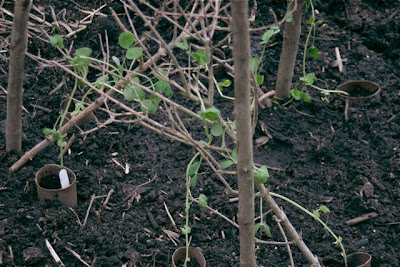
Outside, I've started hardening off the first legumes I started soaking 6 weeks ago. They went from indoors proper (warm), to a cool spot by the front door for a couple of days, to the front step, which is sheltered but at the ambient outdoor temperature. They've thrived, and the first six purple-podded peas went into the front garden earlier this week. The broad beans - six 'Aquadulce longpod' and around 8 of an unknown variety that I bought as dried pulses from a local shop, are around 30cm tall, and will go in soon. Potatoes, which have sprouted nicely ('Red Duke of York' I think, though I've misplaced the label) have been put into four large planting bags - two tubers each. Plants I don't want - like red valerian (Centranthus ruber), which I like but find rather invasive; couch grass; dandelions and the like - are just sprouting, and have been fairly easily removed (though they will return).

The grow bags I grew most of my tomatoes in last year are spent, but they will be useful as a soil conditioner and mulch - they are largely free of weed seeds, and full of worms, and although most of their nutrients will have been exhausted, they raise the soil level, lighten its texture, and I am adding nutrition back in by sprinkling blood, fish, and bonemeal, and adding homemade compost.

There's a fair amount of sorting and shifting to do. The two raised beds I built last year became infested with couch grass despite weed-suppressant fabric underneath - the grass just pushed through. I've removed the soil, added a second layer of fabric, and fresh compost. The old soil will be thoroughly sieved and likely rested somewhere for a few months, to prevent the spread of this most pernicious weed (if it resprouts, I'll attack it until it's too weakened to return). I've enough materials for one more bed, and enough room for another, albeit odd-shaped one in the front - that gives me enough space for some peas and beans, garlic, and chard, with gaps around for perennials and ornamentals - rosemary, lavender, alliums, and later marigolds, nasturtium, and cosmos.

Yesterday, I started on the back garden. It's been hanging over me, but once I scouted round I thought about it, I realised the situation is quite manageable. I cleared out the fire pit/barbecue, and lit it, as I've lots of prunings and dry material that is best burned. Over a few hours, I disposed of lots of buddleia, raspberry, privet, brambles, grass, tomato plants, and calendula - all essentially brushwood - and the old willow hurdles that surrounded two large planters, that after two years have become too brittle to keep. They all burned well, and will provide nice sweet ash for nourishing fruit plants and root vegetables in particular.

These sturdy bags have been part filled with compost, and planted with two chitted seed potatoes each. I'll top them up with more compost as they grow. There are four altogether, and I may get a few more yet.

I gathered intact plastic pots and trays, that had blown hither and thither, for cleaning and reuse. Plastic waste (mostly pop bottles and plastic cups used in last year's sowing and watering) can be recycled. Other stuff will be thrown away (polystyrene, plastic bags that have blown in, that sort of thing). Pernicious weeds will go to municipal composting, benign stuff will be rotted down here. After that, a bit of sweeping and pruning, and I can set to fixing the broken greenhouses, relaying the terrace, painting, and the like. A fair amount of work, but nothing I've not done before.

Incidentally, a great deal has survived the winter - tulips, lemon balm, even a tray of mixed salad leaves. And life is returning - birds, ladybirds and seedlings abound (mostly unwanted in the latter case). Spring is a good time.

*Admittedly I am writing this from the perspective of my own garden. Here by the sea, there are few frosts in April (none last year) and almost none in May - although traditional gardening wisdom cautions they may occur as late as June, in my experience this is almost unheard of, especially nowadays.

Sunday, 11 March 2012

In lieu of an allotment

It's definitely spring - the frogs are swarming through my friends' (and their neighbours') garden, and there's plenty of spawn. Frogs can be startling when disturbed, but are useful for keeping down numbers of slugs and snails.

Last October, the waiting list for the allotment site I visited in August stood with person #19 at the top - I am #45. As of just now, nothing has changed. That's pretty galling - that there has been no movement in nearly half a year. I don't expect to be around here for long enough to get even close to the top of the list - which is a shame, because the site is really lovely.

But a couple of years ago, before I ever considered such a formal move, I had another idea. My friend, who I helped with tomatoes last summer, has a large (classic, metal-framed, glass) greenhouse, and a long garden, in which she and her fiancé have started carving a garden - including raised beds. It crossed my mind I could make use of some of the space - they like the idea of a garden, but are very busy and not totally sure about what to do. But I pushed it from my mind - they live far enough away that I might not have been assiduous in visiting, and a garden needs discipline. And last year, they made some effort of their own accord - I gave them plants, and a little advice, but let them see how it went for themselves.

However, I decided to make my suggestion a week ago, partly because I know they had an imperfect time last summer. It was a bad year for tomatoes, and although their chillies and runner beans thrived, I don't think they felt terribly spurred on by the experience. Surprisingly, they were very keen, so I've effectively doubled my planting space. So here's the plan:

I sent them a list of the seeds I have. They picked what they most wanted to grow and eat. That's the core of the planting - because it's their space, and because it will hopefully encourage them if they can pick what they enjoy eating. Most of what they wanted can go in now - beetroot, spinach, carrots, onions, salad leaves, radishes - and the rest (such as squash) can follow on in two or three months. The idea occurred that, in the time before the tomatoes and peppers go in their final positions (we have both sown some, and can share plants and varieties, in case either of us suffers unexpected setbacks), I can sow some pots of spinach, carrots, and beetroot in the greenhouse to get a faster crop - perhaps a couple of weeks to a month earlier than the outdoor crops.

I went over today, to check out the space (it's been a few months), and get started. We made excellent progress - all the crops were sown, except the 'forced' roots and leaves, which I'll set to next weekend. We also got in some sweet peas, basil, and yet another variety of tomato, seeds of which my friend had lying around. I had bought some onion sets last week, and those went into modules to start off, ready for planting outdoors in a week or two. I also helped clear some of the perennial weeds.

Fresh sowings. In a week, the first shoots should have emerged - even on a resolutely cloudy day like today, the greenhouse was much warmer than outdoors.

The raised bed. My friends may build more, but for now, this is the centre of outdoor planting. We divided it into four, sowing three sections with two rows each of carrots 'Amsterdam 3 sprint', spinach 'Medania', and beetroot 'Boltardy'; the fourth will be planted with onions.

At the centre here is a bed of blackcurrants - they give a crop every year, but are swamped by brambles and what my friend describes as 'grass', although I suspect it may be a member of the lily family. [Edit: it's actually pendulous sedge Carex pendula, a native British plant related to grasses].

After a concerted attack with a sturdy knife and secateurs, I've made some headway - I'll continue on my next visit.

Having a second garden to tend to has already encouraged me to do some work in mine - I'm hoping I'll learn a bit of discipline this year, something I could use a lot more of.

Saturday, 18 February 2012

New life

I mustn't let things slip here too much - I have a backlog of articles again! To keep things ticking over, this is a quick photographic update on my seedlings.

When chillies, aubergines, and tomatoes germinate, they emerge as a little thread like this, straightening out after a few days.

These are chilli seedlings.

I tend to pre-soak large seeds, like sweetcorn, peas, and beans. It's useful for older seeds especially, allowing you to see which are viable and which are dead. These have been neglected though - their main root has withered, but they should recover.

After a couple of days, the peas (in this case, purple-podded) begin to grow towards the light.

The broad beans are treated likewise. This is 'Aquadulce longpod', a robust green-seeded variety.